|
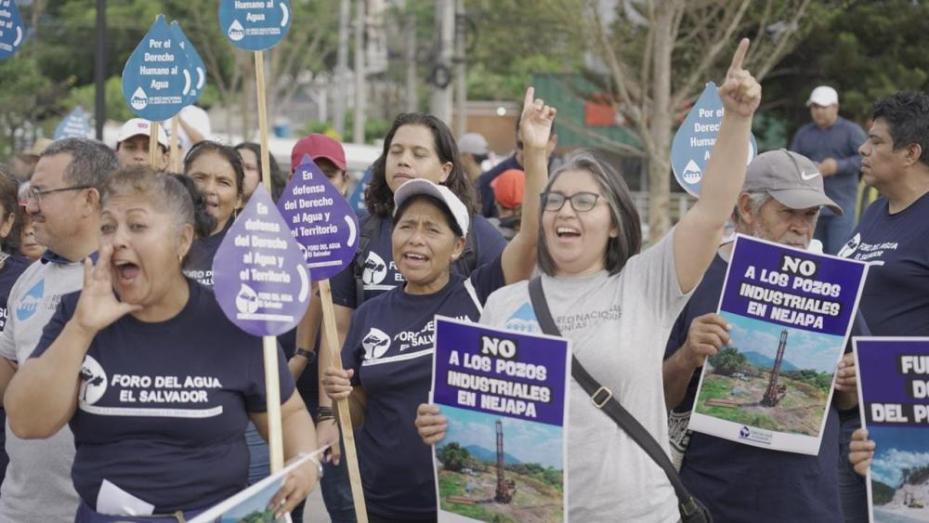
- A non-violent protest had been organized in
Suchitoto for Monday morning, July 2nd, 2007.
The protest was organized by the Association for the Development of El
Salvador (CRIPDES), its regional branch in Suchitoto (PROGRESO), and the people
of the organized rural communities in that municipality, as well as the the
Union of Water Workers (SETA) and a number of other social organizations.
- This protest coincided with the visit of President
Elias Antonio Saca and his cabinet to Suchitoto. The purpose of this visit was to inaugurate
the public water system in the municipality and with it a “Plan for the
Decentralization of Public Services,” a policy which is viewed as a step towards
privatization of the public water system.
The communities, organized and accompanied by CRIPDES, staged a
demonstration and other public protest activities around the visit of President
Saca and in opposition to the movement toward privatization of water.
- Four members of the Association for the Development
of El Salvador (CRIPDES) were arrested before their vehicle reached the
protest, when their vehicle was stopped by National Civilian Police (PNC)
several kilometres before they arrived in Suchitoto, outside the community of
Milingo. There a police car pulled in
front of them and blocked their path, and officers forcefully arrested the
following people: Marta Lorena Araujo, President of the CRIPDES National Directive
Council; Rosa Valle Centeno, Vice-President CRIPDES National Directive Council;
María Haydee Chicas, CRIPDES journalist and photographer; and Manuel Antonio
Rodriguez, driving the CRIPDES vehicle.
- Manuel Antonio Rodriguez, the driver of the vehicle,
was struck violently by police officers immediately after the officers
approached the car. All four CRIPDES
members were handcuffed and thrown into an army vehicle, which took them
through back roads to the police station in Suchitoto.
- Shortly thereafter, the CRIPDES leaders arrested were
taken from Suchitoto police station to Cojutepeque, the capitol of the Cuscatlán Province. From there they were then taken to the police
station in Santa Cruz Analquitos, to the south of Cojutepeque. As of July 4, all the detainees were being
held once more in Cojutepeque.
- Those arrested were charged with “Creating Public
Disorder,” and lawyers who had been in contact with the police headquarters in
Cojutepeque confirmed that their case will be designated under those charges to
the Cojutepeque departmental attorneys and court system. Under Salvadoran law the departmental
prosecutors have 72 hours (that is, until late morning or midday on the 5th of
July) to present charges at a public hearing.
- Despite the charges of “Creating Public Disorder,”
the CRIPDES leaders arrested never came close to the protest activities being
carried out in Suchitoto. News footage
shown on the Salvadoran Tele-Corporation (TCS) channels clearly showed the
police vehicle overtaking the CRIPDES truck on the paved road between Suchitoto
and San Martín, swerving in front and stopping the CRIPDES leaders. The video also shows the police forcefully
removing the passengers from the pick-up truck, and taking them away in
handcuffs, several kilometres away from where the protest took place. (Some news footage can be viewed at: http://www.youtube.com/watch?v=-e9Npsw4Xl8)
- When news of the arrest reached the protesters in
Suchitoto on the morning of July 2, the people moved from the central park
protest site to the police station to demand information and the liberation of
those arrested.
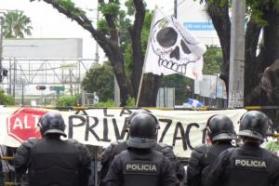
- The police found themselves surrounded, and called
in the “UMO” (Unit for Maintenance of Order) Riot Police, who forcefully
dispersed the crowds with tear gas, rubber bullets and wooden batons.
- Repression of the protest was not limited to the
crowd at the police station; rather it was widespread. As of the evening of July 3, preliminary
reports indicate that a total of 13 people were arrested (including the 4
CRIPDES members and 9 local community members), 25 injured by rubber bullets,
18 suffering serious effects of tear gas, 2 hospitalized, and an undetermined
number beaten by police officers.
- In the community of Guillermo Ungo, several
kilometres south of Suchitoto, where the UMO riot police attacked community
members on the road on their way to the Suchitoto protests, again using rubber
bullets and tear gas, forcing the community members to flee into the hills. Police also entered the homes of community
members in Guillermo Ungo without legal warrant to do so.
- Fleeing community members were followed by the UMO
riot police and the Police Reaction Groups (GRPs) by land and by air for more
than 4 hours, with several arrests made.
School classes in the nearby community were suspended because of the
effects of the tear gas.
- The local community members captured report
psychological intimidation after their arrest.
One report reveals that detainees were taken in a helicopter above Lago
Suchitlán and told by the police holding them that they were going to be thrown
out of the helicopter.
- These specific tactics of repression, intimidation,
persecution by helicopter, and invasion of homes are reminiscent of the most
painful and disturbing moments of the armed conflict in El Salvador during the 1980’s. This repressive events of July 2 represent a
step backwards in the process of building democracy that was proposed with the
signing of the Peace Accords of 1992.
- Meanwhile, on the same morning as the protests in
Suchitoto, the PNC and Salvadoran Armed Forces concluded a massive operation of
some 300 officers who worked to capture Mario Belloso, the man accused of
killing two police officers during a protest last July. Belloso was apprehended
in his own home during the early morning and then paraded in front of news
cameras shortly thereafter. The story
filled newspaper and television reports and gave Minister of Security Rene
Figueroa and PNC Director Rodrigo Avila the opportunity to attack youth
organizations and the FMLN, insinuating that these groups have been aiding Belloso in his
efforts to evade arrest over the last year.
- In the raid
of Belloso’s home, the PNC claims to have found FMLN paraphernalia, along with
specific documents in his computer that tie him to various youth
organizations. Perhaps the most
ridiculous claim made by President Saca is that Belloso was the “intellectual
author” of the disturbances in Suchitoto; Figuero and Avila, meanwhile, accused the FMLN of being
behind the protests. In an official
communiqué following the arrest of Belloso the FMLN stated that, “We reject and
repudiate the coarse pretenses of extreme right-wing politicians, as well as
certain news media aligned with the party in power, who are blaming our party
for the regretful events of July 5, 2006. Only perverse minds would have the
courage to make such unfounded accusations”.
Human Rights Office ombudswoman Beatrice de Carrillo called the arrest a
“political show” by the government, while Ricardo Alfaro Barahona of the Forum
for the Defense of the Constitution raised questions about the timing of the
arrest, as it coincided precisely with the police repression in Suchitoto.
- On the
morning of July 5, the prosecutors asked for an extension to make formal
charges and the courts gave them until Saturday morning, and it came out that
there are actually 14 people who were arrested.
Unlike usual procedure which would have had that hearing in a the main
court system, this case is being heard in the special, expedited tribunals
created this December under the “anti-organized crime” law meant to hear cases
against those charged with participation in organized crime. There is already one high-profile case moving
through these special tribunal courts (of questionable constitutionality) – the
state’s case charging street vendors with terrorism and organized crime. See here for more information about the
vendors . This case against the water protestors is now
the second case of the government using the new terrorism and organized crime
laws against the organized social movement.
For an analysis of the anti-terrorism charges, see “The Salvadoran
Anti-Terrorism Law and its Mirror Image”.
|