|
Download report
(Spanish version coming soon)
Contact: Burke Stansbury –
202-521-2510 ext. 205 or
This e-mail address is being protected from spam bots, you need JavaScript enabled to view it
A recently returned delegation to El Salvador has published a report on human
rights abuses, the potential for fraud and intervention in the 2009 Salvadoran
elections, and the role that the US government
has played in the cited injustices. The delegation was organized by
the Committee in Solidarity with the People of El Salvador (CISPES) and
was made up of 17 US citizens and residents.. The introduction to the report explains its intended
purpose of “offer[ing] elected officials, the media, and concerned citizens a
description of the deterioration of human rights in El Salvador…[and] the
potential impediments to true democracy faced by the Salvadoran people as they
approach a crucial election period in their
country.”
Callie Arnold, a delegate from Seattle, stated “We feel
that US citizens and residents should be aware of and concerned by the
injustices carried out in El Salvador — particularly the many that our
government has a hand in — and we hope this report will get people talking,
increase media coverage, and encourage elected officials to take action.” The
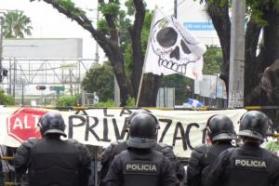
Human Rights section of the report cites evidence that the existence of the
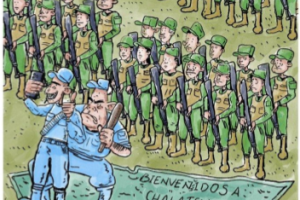
International Law Enforcement Academy (ILEA) — a police training institution in
San Salvador that is funded and administered by
the US — has coincided with “an increase
in repression, including arrest and torture of citizens involved in peaceful
protests.”
The section of the report entitled “2009 Elections and
the Electoral Process” further calls into question the role of the US
government in the Central American country. It cites instances leading up to
the 2004 presidential elections in El
Salvador in which the US
“interfered with the ability of Salvadorans to choose their preferred
candidate.” It goes on to discuss “similar patterns of US
political involvement in the period leading up to the 2009
elections.”
Andrew Kafel, a delegate from New
York, says, “The current state of the economy in El
Salvador is dire. The Central American Free
Trade Agreement has devastated the country and the 2009 elections offer
Salvadorans an opportunity to bring about democratic change that will better the
state of their country. This is why it is so important that they be allowed to
freely choose their next government.” On January 18, 2009, El
Salvador will hold municipal and legislative
elections; on March 15 presidential elections will take place. The leftist
Farabundo Martí National Liberation Front (FMLN) holds a significant lead in
presidential polls over the ruling right-wing Republican National Alliance
(ARENA). Kafel went on, “It is clear the people of El Salvador want change and we believe it is of
utmost importance that the US stay out of their elections and
allow for self-determination.”
The report also describes a meeting with US Ambassador
to El Salvador Charles Glazer as “a highly rhetorical and hostile propaganda
exercise with the delegates.” Rosa Lozano, a delegate from Washington D.C.,
stated, “The Ambassador’s behavior and demeanor was troubling, but it was
especially surprising that when directly asked about US involvement in the 2004
elections, he admitted that the US had intervened. That is why it is so
important that this report be published and for US citizens and residents to
pressure our government not to repeat this intervention in
2009.”
The complete report can be downloaded here
or obtained by contacting CISPES’ National Office in Washington DC at 202-521-2510. For more information go
to www.cispes.org.
|