El Salvador Holds So-called Human Rights Summit While Criminalizing Victims of the Regime
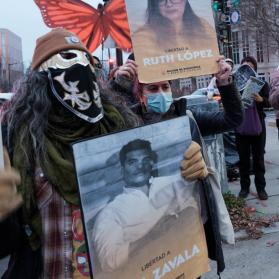
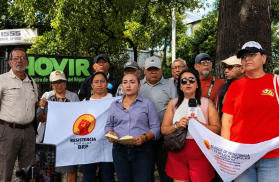
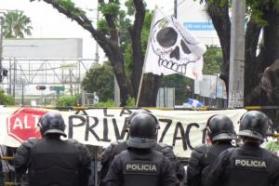
On September 3, 2025, around 50 members of the Movement of Victims of the Regime (MOVIR), including mothers, daughters, and grandmothers, were temporarily detained by the National Civil Police (PNC) while attempting to approach the cynically-named First Global Human Rights Summit organized by the Office of the Ombudsperson for the Defense of Human Rights (PDDH). MOVIR’s aim was to submit a statement denouncing serious human rights violations under the state of emergency in effect since March 2022, including arbitrary detentions, deaths in state custody, and the criminalization of human rights defenders.
The summit brought together delegations of far-right networks and movements from more than 25 countries, including the United States, Spain, and Brazil, but deliberately excluded local human rights organizations, such as MOVIR and Cristosal. Samuel Ramírez, a member of MOVIR, questioned the omission, stating that “those of us who continue to fight for the victims of this repressive state—one that marginalizes, arrests, and kills the poor in prisons, communities, and hospitals—were forgotten.”
Ramírez, a member of MOVIR, denounced that the summit sought to “hide the violations occurring in the country and impose an official narrative,” and criticized the Human Rights Ombudsperson, Raquel Caballero, for “avoiding listening to the victims and remaining silent in the face of prison deaths, illnesses, and overcrowding,” which contradicts the mission of the PDDH—an institution established as part of the 1992 Peace Accords to protect human rights, oversee the respect of constitutional guarantees, and provide assistance to victims of state abuses.
Among the invited guests was Macarena Olona, a former deputy of the Spanish far-right party VOX, known for repressive and xenophobic positions, who publicly praised the Salvadoran government’s security model, including the Terrorism Confinement Center (CECOT). For MOVIR, the presence of foreign delegations became an act of complicity, as they had no access to the victims or detention centers and were presented only with the official version that conceals arbitrary detentions, torture, deaths in custody, and the criminalization of defenders.
While humanitarian organizations have received over 6,400 complaints of arbitrary detention and torture, reports indicate that since the implementation of the state of emergency, more than 88,000 arbitrary arrests have been recorded, fundamental rights such as legal defense have been suspended, and over 400 deaths in state custody have occurred, many showing signs of violence. Meanwhile, the summit projected the image of a country as “an example in human rights and reconciliation.”
In addition to being ignored and excluded by the PDDH and the state, members of MOVIR and other organizations have long denounced surveillance, persecution and defamation of human rights defenders. In March 2025, Alfredo Mejía, a MOVIR activist, reported police monitoring of him and his family following his speaking out about his daughter’s detention in April 2022. “If I am in MOVIR, it’s not because I am defending criminals; I am defending my daughter, who is innocent, and that is why I have faced all the media,” Mejía stated. More than 100 people have been forced into exile due to repression under Bukele’s regime in 2025, including journalists, lawyers, academics, environmentalists, and human rights defenders—the largest exodus due to political persecution since the civil war (1979–1992). The Association of Journalists of El Salvador (APES) reports that at least 40 journalists have left the country, while Cristosal estimates that 24 activists have been detained and many others have opted for exile.
Even in the face of this escalation of intimidation, surveillance, and arbitrary detentions against activists and defenders, MOVIR continues its work documenting and denouncing abuses against the population. Recently, it announced that it will participate, alongside other expressions of the social and popular movement, in a peaceful march scheduled for September 15, Central America’s Independence Day, to speak out against human rights violations and protest the state of emergency.
Ramírez affirmed that the peaceful demonstration will proceed despite disinformation campaigns and obstacles imposed by the government: “We want to tell the Salvadoran people that there will be a march, rain or shine, no matter what. It is such an important date, where independence is discussed, and in this country, there is no independence.”
As they have stated before, MOVIR will exist and resist as long as abuses persist and attempts continue to silence those seeking justice for victims and their families.
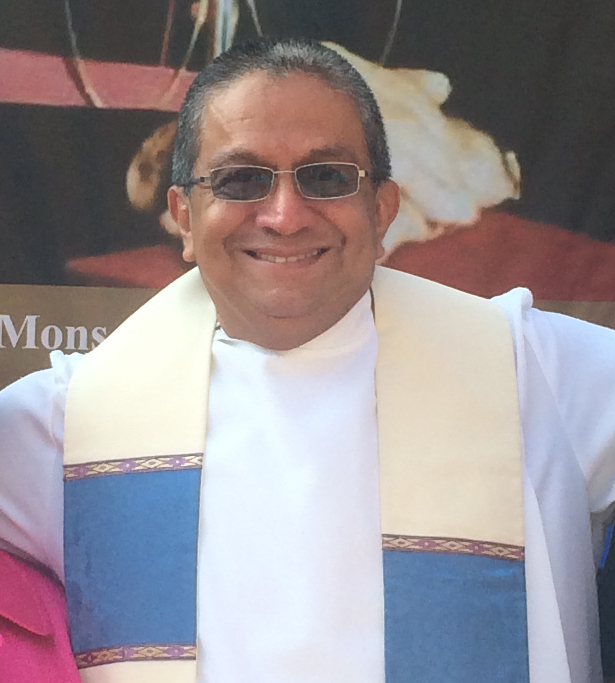 "I am a CISPES supporter because continuing to fight for social justice and a more people-centered country means continuing the dream and sacrifice of thousands of my fellow Salvadorans who died for that vision.” - Padre Carlos, New York City