Experts warn of potential crimes against humanity Despite Denialism by Bukele and US Government
In April, members of Congress and participants in "The State of Exception in El Salvador: Year Five" hearing—held by the Tom Lantos Human Rights Commission—challenged a recent State Department annual report (published in August 2025), which claimed there were "no credible reports of significant human rights violations" in El Salvador. Throughout the hearing, the vast majority of participants testified that the State Department’s conclusion contradicted the documentation human rights experts had amassed over recent years and argued that the United States should cease being "complicit" in these abuses, calling for any assistance to El Salvador to be made conditional upon demonstrable improvements in human rights.
Susana SáCouto—Director of the War Crimes Research Office at American University’s Washington College of Law— testified and presented on the findings of a nearly 300 page report she co-authored titled “El Salvador at a Crossroads: Crimes Against Humanity in the Context of Public Security Policy,” which, unlike the State Department, concludes that "there are reasonable grounds to believe that [...] crimes against humanity are being committed" in the country under the State of Exception. The report's findings, which had been presented to the Inter-American Commission on Human Rights just a month earlier, is the result of an investigation carried out by prominent independent jurists from various countries, known as the International Group of Experts for the Investigation of Human Rights Violations in the Context of the State of Emergency in El Salvador (GIPES).
The research received support from the Due Process of Law Foundation (DPLF), the International Commission of Jurists (ICJ), the International Federation for Human Rights (FIDH), InterJust, the IMPACTUM Research Project, and the Program for the Study of Human Rights in Context at Ghent University (Belgium) and was prepared based on an examination of documents and statements from the Salvadoran government, journalistic investigations, and national and international reports, as well as meetings with victims, civil society representatives, academics, lawyers, and journalists.
The report notes that, over the course of more than four years, rights related to due process, access to legal counsel, and limits on pretrial detention have remained suspended; it maintains that “the state of exception in El Salvador has transformed into a permanent policy that undermines the national legal order” and that thousands of detained individuals have no proven ties to gangs. Furthermore, it documents more than 500 deaths in state custody and asserts that the detentions have disproportionately affected “a young population living in poverty or extreme poverty… residents of economically disadvantaged neighborhoods.”
According to the report, practices such as arbitrary detentions, torture, enforced disappearances, persecution, and deaths in custody “are part of a deliberate, widespread, and systematic plan driven from the highest levels of state power.” It also maintains that these violations “require an institutional environment that enables, plans, executes, and normalizes them.”
Under international law, crimes against humanity are among the gravest offenses recognized by the international community; they are not subject to statutes of limitation and can give rise to individual criminal responsibility for those who ordered, facilitated, or failed to prevent them. As a result, findings that there are reasonable grounds to believe such crimes are being committed carry potential legal and reputational consequences that could persist long after the State of Exception ends or political leaders leave office.
Noah Bullock, director of Cristosal, and other experts testifying before the Tom Lantos Commission concurred with the GPIES analysis that the Salvadoran government has turned human rights violations against detainees into state policy. “We learned from overwhelming testimonial evidence backed by forensic analysis the patterns of torture at CECOT,” Bullock stated. “The things that [prison] guards say and threats that they make, the practices of torture coincide exactly with the same patterns we’ve documented in other prisons indicating that torture has become a state policy within the Salvadoran prisons.”
However, in the U.S. State Department report on El Salvador—published in August 2025 under the tenure of Secretary Marco Rubio—the Department reached a conclusion starkly different from the testimonies and reports presented to Congress, simply stating: “There were no credible reports of significant human rights abuses [in 2024].”
For his part, Congressman Jim McGovern (D-MA), co-chair of the Tom Lantos Commission directly challenged the State Department report's content, stating, “This is a lie. I’ve been [to El Salvador] and I’ve seen the results of these abuses with my own eyes and I’ve talked to countless Salvadorans who have come to Washington to give me their personal testimony ...This is an insult to all those whose human rights have been violated. This is a cover up.”
McGovern pointed out that, between 2019 and 2023, the State Department’s own reports did document abuses committed by Salvadoran security forces, both inside and outside prisons. Consequently, McGovern believes that the conclusions of the 2024 report reflect “either a shocking ignorance of what the reality is or it’s intentional.”
It’s worth noting that months before the publication of its report on El Salvador, the State Department had already shown interest in removing barriers to cooperation with the Bukele government. After visiting El Salvador and Guatemala in February 2025, Secretary Marco Rubio promoted the possibility of the U.S. sending “criminals” to be incarcerated in El Salvador, announcing a waiver for security assistance notwithstanding a global freeze on international cooperation. In April 2025, the State Department certified that El Salvador was meeting all the conditions requiring human rights, judicial independence and anti-corruption guarantees in order for El Salvador to receive funding from the U.S. government. By the time of the certification, the U.S. government had already transferred approximately $4.76 million to the Central Reserve Bank of El Salvador to fund the incarceration of Venezuelan migrants, among other law enforcement and anti-crime needs.
During her speech at the Tom Lantos hearing, Congresswoman Ilhan Omar expressed that she was “particularly struck by the disturbing parallel” between the state of exception in El Salvador and the anti-migrant policy of the United States, mentioning “the use of quotas that incentivize arbitrary arrests”, “prejudgment of detainees based on appearances”, “arbitrary detention” y “failure to follow judicial orders”. She further added: “There is no acceptable justification for the violation of these fundamental rights in El Salvador, in the United States or anywhere in the world”.
Following the congressional hearing, President Nayib Bukele reacted on social media, accusing human rights organizations, journalists, and hearing participants of seeking "the release of 100% of the gang members arrested during the state of exception." The president asserted that those who took part in the discussion before the U.S. Congress "defend terrorists" and seek to "turn us back into the most dangerous country in the world."
Bukele also referred to the report presented to the Inter-American Commission on Human Rights (IACHR), maintaining that a group of "experts" went there "to, basically, ask for the release of 100% of the gang members arrested during the state of exception."
In response, Santiago Cantón—one of the co-authors of the GIPES report—had already publicly rejected that interpretation. "Nowhere in the report does it say that the group recommends releasing 89,000 prisoners," he stated. Cantón explained that the document proposes reviewing detentions "case by case" and maintained that "innocent people have to get out of there."
Ivania Cruz, a lawyer and human rights defender who was forced to seek political asylum in Spain after facing persecution for her anti-corruption and human rights defense work, has also pointed out that thousands of people remain detained for years without a verdict—what she termed "punishment in advance"—within a system where mass hearings and restricted access to legal defense severely limit individual rights. Added to this are allegations regarding practices such as searches without warrants, restrictions on communication with family members and lawyers, and precarious prison conditions.
For Cruz, the international report by GIPES marks a turning point by bringing these allegations to a global stage, given that "it is no longer just a matter of domestic complaints. It is an external, independent assessment that calls the official narrative into question.”
####
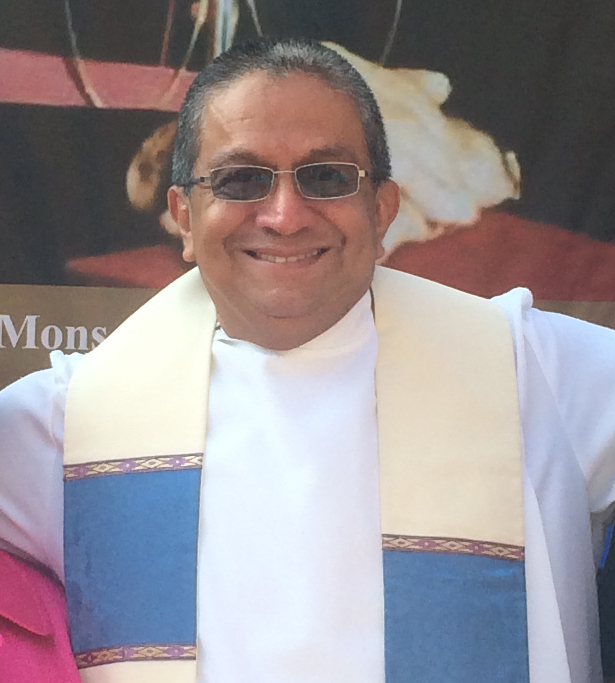 "I am a CISPES supporter because continuing to fight for social justice and a more people-centered country means continuing the dream and sacrifice of thousands of my fellow Salvadorans who died for that vision.” - Padre Carlos, New York City