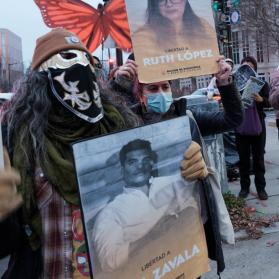
International condemnation of Bukele's human rights abuses and political repression continues to grow
Concerns regarding human rights abuses in El Salvador - and government repression against those who denounce them - continue to grow at the international level. The latest wave of condemnation came in response to the November 12 release of Cristosal and Human Rights Watch’s joint report "You Have Arrived in Hell: Torture and Other Abuses Against Venezuelans in El Salvador’s Mega Prison." The report made global headlines and prompted a swift response from dozens of U.S. Congressional Representatives and is just one of several recent examples of a shift in global perception of the Bukele government.
Just a week after the report's release, several United Nations human rights experts released a statement calling the Bukele government’s issuance of Interpol “red notices” against Salvadoran human rights lawyers, Rudy Joya and Ivania Cruz, “an act of transnational repression.” Through their organization, the Human and Community Rights Defense Group (UNIDEHC), Cruz and Joya had filed several lawsuits with the country's courts regarding the conditions of torture and abuse inside the prison system. The lawyers are now seeking political asylum in Spain after the Salvadoran government issued arrests warrants for them in February.*
The experience of forced exile is shared by hundreds, including organizations like Cristosal, co-author of the "You Have Arrived in Hell" report. The report is based on forty detailed testimonies from Venezuelan migrants whom the U.S. State Department paid the government of El Salvador nearly $5 million in a secretive agreement to jail in its notorious Terrorism Confinement Center (CECOT) between March and July of 2025. The terms of the agreement between the two governments were only made public as a result of a lawsuit by a coalition of U.S. immigrant rights organizations and criminal defense lawyers.
The report describes beatings, denial of food and water, sexual violence, prolonged solitary confinement, and what Cristosal’s Executive Director Noah Bullock calls an institutionalized system of torture. As Bullock told Democracy Now!, “Torture is institutionalized in Salvadoran prisons. It’s a state policy… [it’s] impossible that this is the actions of bad guards or bad apples.”
Bullock also emphasized that the U.S. rationale for sending these Venezuelan migrants, whom they accused of being members of the Tren de Aragua gang, to a “terrorism” facility was baseless: “These people were migrants seeking protection; they weren’t terrorists or security threats to the United States.” More than half of 130 cases investigated for the report had pending political asylum or other immigration protections.
U.S. Congressional Response
In response to the report, 43 members of Congress wrote a letter urging the Secretary of State Marco Rubio and Secretary of Homeland Security Kristi Noem “to investigate [the report’s] findings and provide an immediate explanation to Congress and to the American people for the Trump Administration’s complicity in subjecting these individuals to such horrific and cruel treatment.”
Senator Peter Welch (D-VT) also released his own statement in response to the report describing “a prison … where everyone, innocent or guilty, is labeled a terrorist” and where “[c]riminal proceedings, if one can call them that, are conducted en masse and make a mockery of due process[...]” Senator Welch also had a message for President Bukele, whose leadership Trump has “feted”: “President Trump’s term expires on January 20, 2028, after which he will no longer be there to turn a blind eye to Bukele’s role in presiding over the torture and denial of fundamental rights of tens of thousands of prisoners,” speaking to experiences of the nearly 90,000 people the government of El Salvador claims to have imprisoned under his so-called war on gangs.
Senator Tim Kaine (D-VT) expressed a similar position earlier this year when introducing a resolution in the senate to require a human rights report under the Foreign Assistance Act, stating “President Bukele may think he has a friend in President Trump, but he should know that Americans will not tolerate his efforts to undermine the rule of law and democratic institutions—whether in El Salvador or here in the United States.” The resolution, which was blocked by Senate Republicans, also requested information on the treatment of U.S. citizens (like Virginia father Walter Huete) who have been jailed for years without warrant or trial under El Salvador’s now indefinite “state of emergency.”
More recently, in September, a group of eighteen House Democrats, led by Representatives Jim McGovern (D-MA), Norma Torres (D-CA) and Jaime Raskin (D-MD), ranking member of the House Judiciary Committee, sent a letter to the State Department and the Department of Homeland Security expressing concern that by deporting migrants to El Salvador, where human rights abuses against prisoners are well documented, the U.S. was violating its commitment under the international convention against torture. The letter also cited reports of inhumane conditions at the CECOT and throughout El Salvador’s prison system, where national and international human rights organizations had thoroughly documented beatings, isolation, sleep deprivation, lack of medical attention, and included testimony from Kilmar Abrego Garcia and from many of the 238 Venezuelan nationals. The legislators demanded both that the U.S. facilitate access for international human rights observers and an immediate end to these transfers.
In recent weeks, the Inter-American human rights commission has also granted precautionary measures for four Salvadoran nationals who were on the same planes as the Venezuelans. Prior to responding to the Commission's request, the government of El Salvador denied having found any information on their entry into the country, functionally disappearing them into the prisons.
Bukele's reputation as a right-wing authoritarian figure cements as Trump alignment and complicity with U.S. aggression in Latin America continues
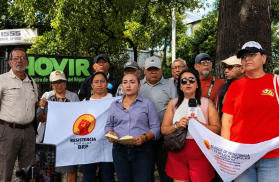
Salvadoran social movement leader, Marisela Ramirez of El Salvador’s Popular Rebellion and Resistance Bloc, a coalition of students, labor unions and community organizations, spoke to the significant global shift in a November 13 interview with Radio YSUCA noting that El Salvador’s Nayib Bukele global reputation is finally being cemented as a far-right authoritarian, commenting that “Little by little, the perception of Bukele has been changing, the violations of the people’s right to organize and express themselves has become clear, and this type of policies extending throughout the region is [now] seen as a threat."
Meanwhile, the Trump administration has continued to praise Bukele, thanking “the country of El Salvador for the successful and professional job they’ve done in receiving and jailing so many criminals that entered our country” in his September 23 remarks to the UN General Assembly. Congressional Republicans have also rebuffed calls for transparency regarding the Trump administration’s agreements with El Salvador, including voting down a budget amendment in July to require the State Department’s Inspector General to report “any information [available] regarding the relationship between the highest level of government in El Salvador and the criminal network known as the MS-13” and recent U.S. actions that appear to undermine the DOJ’s own investigations into top Bukele officials’ negotiations with gangs.
For his part, Bukele has continued to support Trump’s aggression against Latin America, remaining silent in the face of unauthorized U.S. military strikes that have executed over 80 people since September.
On November 6 the New York Times reported that U.S. combat aircraft are being stationed in El Salvador’s airport as part of a dangerous build-up of U.S. military arsenal and troops in the region as the Trump administration threatens to invade Venezuela, Colombia and Mexico. Analysts describe the arrival of the fighter jets as “the first instance of a foreign nation hosting U.S. planes for potential combat roles in this region.”
*Update: On December 6, 2025, Interpol revoked the Red Notice issued against Rudy Joya and Ivania Cruz, setting an important precedent within the current context of widespread political persecution, including transnational political persecution and forced exile that dozens, if not hundreds of Salvadorans human rights defenders, critical social leaders and organizers and journalists from El Salvador are currently experiencing.
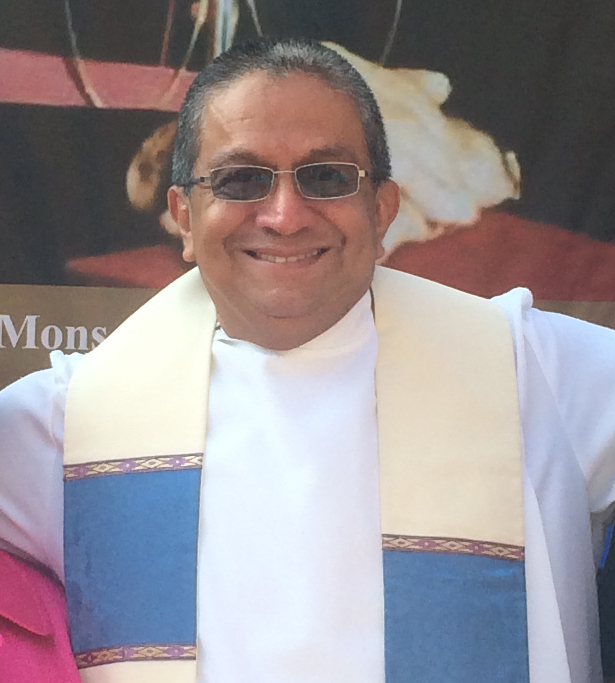 "I am a CISPES supporter because continuing to fight for social justice and a more people-centered country means continuing the dream and sacrifice of thousands of my fellow Salvadorans who died for that vision.” - Padre Carlos, New York City