Reflections on East Coast Political
By Dan Blumenthal, D.C. CISPES
In May 14 & 15, three members of the DC CISPES chapter traveled to New York City to attend CISPES’s regional political school. Though we weren’t sure exactly what to expect, we felt that it would be a good place to learn more about the history of CISPES, the FMLN, and the Salvadoran social movements, to get to know the members of the NY and Boston chapters, and to have discussions about the strategic impact that CISPES can make today. Fortunately, political school exceeded our expectations!
Considering that many of our chapters have new members, one of the main priorities of the political school was to develop a deeper understanding of our own history. We got off to a roaring start on Saturday with a workshop on the Salvadoran liberation movement of the 1970s and 1980s led by historian Joaquin Chávez, who talked about the unique and powerful collaboration between urban intellectuals and organized farmers in resisting and ultimately defeating the military regime. Long-time CISPES organizer Phil Josselyn also shared his perspective on the role of international solidarity, emphasizing that CISPES has remained true to its goal of standing in solidarity with the people of El Salvador despite changing political climates in the U.S.
Hilary Goodfriend and Mara Komoska from NY CISPES facilitated a workshop on the role of women in the Salvadoran revolutionary movement. Hilary shared some findings from her interviews with women in the Salvadoran labor movement, including that several of them expressed reservations about feminism, considering it to be elitist. This revelation took many of us by surprise and led to a lively discussion about the intersections of gender and class struggle. Mara gave a presentation on COMADRES, an organization led by women whose family members were disappeared during the Civil War. We were particularly interested in how they used their status as mothers to maneuver through highly dangerous situations and inspired to learn how resilient they’ve been in their efforts to preserve historical memory and fight for justice long after the end of the war.
Another key goal of the political school was to develop a deeper analysis of the economic systems that have devastated most of Latin America over the past twenty years, the effects of which are becoming more and more visible in the US today. Lisa Fuller, CISPES Program Director, and Eli Latto, Boston CISPES Coordinator, gave a very succinct rundown of neoliberalism and “free” trade. They really connected the dots, showing how neoliberalism is also the guiding philosophy underlying the budget cuts and austerity measures being implemented in the U.S. and around the world. The workshop was an example of the kind of popular education that chapters can do with our members and with allied student, labor, immigrant rights and social justice organizations in our communities. In another workshop, Boston CISPES veterano David Grosser provided some background on Marxist theory and the “crisis of capitalism,” opening up a discussion about what, if any, relevance it has to the problems we face today. Many participants found this workshop particularly exciting, since few of us have had much exposure to philosophies that run contrary to capitalism.
It was also important to talk about how we can move from theory to action! We ended with a workshop on the nuts and bolts of engaging with new people and recruiting new members, one of the most important elements of grassroots organizing. Jacob Blickenov and Ilana Feingold from the National Office got us up out of our chairs and into some funny and illuminating role plays!In our final discussion, we explored where El Salvador might be going in the coming years, wondering how far the new government could go to promote the FMLN’s vision without incurring the wrath of the US government. We also grappled with the threats that powerful, US-backed, right-wing governments in Honduras and Colombia pose towards their own people and toward people’s movements throughout Latin America.
We really enjoyed getting to know fellow CISPES members, as there was a good mix of CISPES “veterans” and first-time attendees. We realized that only through building a vibrant and cohesive community of activists can we most effectively promote our program of solidarity with the people of El Salvador and learn from their inspiring and effective organizing to create change here in the U.S. ¡Adelante! ¡Adelante! ¡Que la lucha es constante!(Let’s move forward! Keep up a constant struggle!)
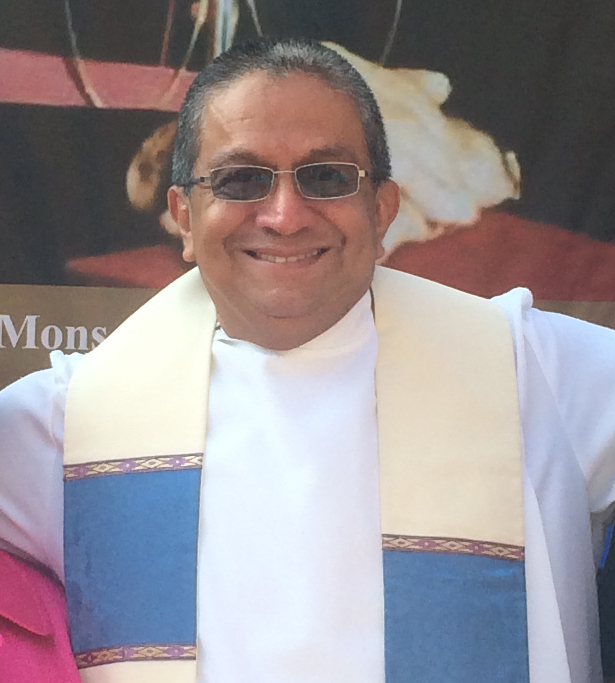 "I am a CISPES supporter because continuing to fight for social justice and a more people-centered country means continuing the dream and sacrifice of thousands of my fellow Salvadorans who died for that vision.” - Padre Carlos, New York City