Urgent calls for TPS renewal for Salvadorans amid unsafe conditions for return
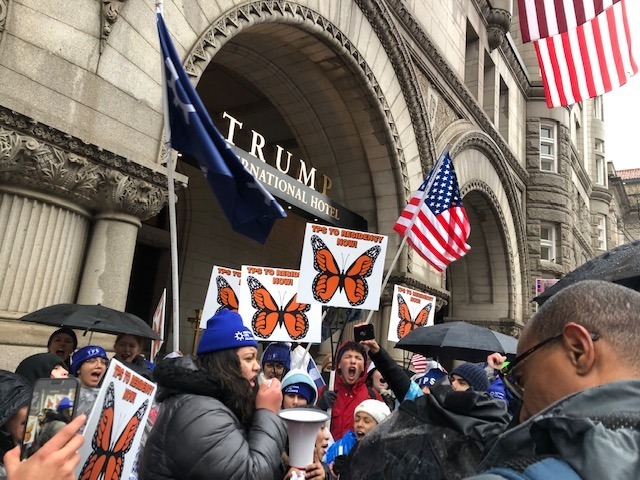
With less than two months remaining before Temporary Protected Status (TPS) for El Salvador expires on September 9, pressure is mounting on the Trump administration to renew the immigration protection that has shielded approximately 200,000 Salvadorans in the United States for the past 25 years. Dozens of members of Congress warn that ending TPS would mean sending thousands of people back to a country where the state itself has been accused of committing serious human rights abuses.
One of the main letters, led by Congressman James McGovern and signed by 80 members of Congress, argues that the need to extend TPS is based on the current reality facing El Salvador, not solely on the earthquakes that prompted the designation in 2001. "The conditions that initially justified the TPS designation for El Salvador in 2001 not only persist, but new humanitarian, economic, and human rights crises have further undermined the country's ability to receive the return of its nationals," the lawmakers wrote.
The signatories, who include leaders such as Joaquin Castro (the ranking Democrat on the House Foreign Affairs Subcommittee on the Western Hemisphere), Adriano Espaillat, Chair of the Congressional Hispanic Caucus, as well as the entire leadership of the Congressional Progressive Caucus, argue that the country is facing a severe human rights crisis stemming from the State of Exception imposed in March 2022. Under this measure, fundamental constitutional guarantees—including due process, the right to legal defense, and freedom of association—have been suspended, while national and international organizations have documented arbitrary detentions, enforced disappearances, mass trials, and more than 500 deaths in state custody.
The letter further argues that ending TPS would expose thousands of people to a real risk of arbitrary detention upon their return, pointing to a "documented pattern of detention and enforced disappearance of deported individuals." Lawmakers cite investigations documenting the imprisonment of people deported from the United States immediately upon their arrival in El Salvador, without judicial review or due process, under the State of Exception.
The letter also argues that the Salvadoran economy lacks the capacity to absorb the return of more than 200,000 people, noting that more than 22 percent of households currently live in poverty, nearly 8 percent in extreme poverty, and that the formal labor market generates very few jobs for those seeking work. In this context, ending TPS could deepen the humanitarian crisis and fuel new cycles of migration similar to those that originally led to the program's creation.
"Terminating TPS for El Salvador would send these deeply rooted community members to a country plagued by documented state-sponsored human rights abuses and without the means or capacity to absorb tens of thousands of people," the lawmakers state.
In a separate letter to the Department of Homeland Security (DHS), Representative Luz Rivas (D-CA) highlights the deep roots of the Salvadoran community in the San Fernando Valley within her district and the vital role TPS holders play in their communities.
Even members of Congress who have publicly praised Bukele's administration and security strategy—such as Representative Tom Suozzi (D-NY), who participated in a Prayer Breakfast organized by the Salvadoran president in January of this year and Representative Adriano Espaillat himself (who attended the inauguration of Nayib Bukele's unconstitutional second term)—acknowledge that ending TPS would have devastating consequences and that El Salvador is not in a position to receive hundreds of thousands of returnees. Suozzi therefore advocates for a two-year extension that would give Congress time to pursue a permanent immigration solution.
Representative Espaillat explained in another personal letter that "the decision regarding TPS carries a political responsibility for the United States toward a community that has complied with the law for decades, undergone repeated background checks, and built their lives in this country." He frames the decision before Secretary Mullin as follows: "You can renew TPS for El Salvador, strengthening families, communities, and our nation's economy, or you can wreak havoc on the lives of 170,000 fully vetted Salvadoran TPS beneficiaries and the 277,000 U.S. citizens—including 150,000 children—who live with them."
Ending the program could force these families to separate while leaving thousands of TPS beneficiaries vulnerable to losing their immigration status and facing deportation proceedings.
These positions underscore the dilemma facing some Democratic lawmakers who, despite expressing admiration for Nayib Bukele, now defend the continuation of TPS. Their letters’ ldefense of the TPS community rest on grounds that differ from those advanced by McGovern. Rather than basing the extension on the documented evidence of human rights violations and the risks that the State of Exception poses to returning and deported migrants—a reality the Bukele government continues to systematically deny—they emphasize other considerations.
The extensive documentation of the Salvadoran state's inability to guarantee public safety, respect for human rights, and opportunities for economic reintegration calls into question Bukele's official narrative that El Salvador has become a destination for migration. During the Bukele administration, El Salvador's embassy in Washington, D.C., has promoted a narrative of "reverse migration," falsely suggesting not only that the country is prepared to receive its diaspora and guarantee a safe return, but also that Salvadorans in the United States are actively seeking to return in order to benefit from the changes the government claims to have achieved. In January 2025, former Salvadoran Human Rights Deputy Foreign Minister Celia Medrano refuted this claim, showing that the very figures cited by the government indicated that only 5 percent of respondents said they were ready to return.
In addition to widespread government propaganda that works to cover up the precarity of life in El Salvador, and despite the political closeness between Nayib Bukele and Donald Trump, there has so far been no indication of any agreement or joint effort to protect Salvadoran TPS beneficiaries. Salvadoran government officials have said little publicly about TPS beyond stating that the decision rests exclusively with the United States, while thousands of people continue to face uncertainty about their immigration future. This position marks a break with more than two decades during which governments from across the political spectrum—not only left-wing administrations but also conservative governments—consistently defended Salvadoran TPS holders in the United States, as well as the country's broader migrant community.
In fact, the broad legislative support that TPS enjoys today is the result of decades of organizing by groups such as the National TPS Alliance and numerous community organizations that have mobilized TPS beneficiaries, built alliances across sectors, and raised awareness about the consequences of ending the program. As José Palma, current coordinator of the National TPS Alliance, explained in testimony before Congress while describing the situation facing his family—including his four U.S.-born children: "If we cannot find a permanent solution I’ll be forced to look down the barrel of family separation on top of leaving my life behind to start over in a country I no longer know. Everything will be upended. ...Our TPS families were easy targets because what is evident has not been resolved: We have made our homes here. Today, we cannot simply extend TPS, we seek permanent residency here in the place we’ve called home for decades."
Under the TPS statute, DHS must announce its decision on whether to extend TPS for a designated country no later than 60 days before the program's expiration date. In El Salvador's case, that deadline passed on July 11 without any announcement.
If TPS is not renewed, the United States would be opening the door to a policy of mass deportations to a country where the state is responsible for serious human rights violations and where returning migrants face a lack of employment opportunities, as well as the risk of arbitrary detention and other abuses under the State of Exception.
Learn more about how you can urge your elected officials in Congress to defend TPS holders and support legislation providing TPS holders with a pathway to permanent residency. TPS Solidarity Committee – Action Network.

 "I am a CISPES supporter because continuing to fight for social justice and a more people-centered country means continuing the dream and sacrifice of thousands of my fellow Salvadorans who died for that vision.” - Padre Carlos, New York City