Global War on Terrorism: El Salvador (the Nation)
http://www.thenation.com/doc/20071231/enzinna
GWOT: El Salvador
by WES ENZINNA
[from the December 31, 2007 issue]
In September 2006, after the Salvadoran Congress passed theSpecial Law Against Acts of Terrorism, then-US Ambassador H.Douglas Barclay congratulated the Salvadoran people. "The US and ElSalvador are [now] partners in the war on terror," he beamed. The law,modeled on the USA Patriot Act, establishes a special terrorism tribunaland allows for anonymous witnesses and undercover agents to participatein those trials. It also criminalizes acts such as public protests,street blockades and "publicly justifying terrorism" with punishments ofup to eighty years in prison. More than a year later, this law hasturned scores of Salvadoran citizens into fugitives.
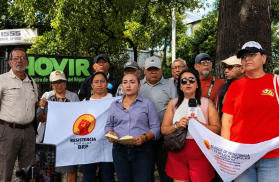
Last July, I spent two weeks in San Salvador chasing down one ofthese ersatz outlaws--Sandra Henriquez, a leader of the SalvadoranNational Vendors Movement. On May 12 the NationalCivilian Police (PNC) raided vendors' stalls, including hers, indowntown San Salvador, attempting to confiscate the pirated goods theysell. The vendors resisted, and a group of angryonlookers--some say provocateurs--set fire to a police car.Shortly after, 150 riot police showed up and subdued the crowd withtear gas and rubber bullets.
Henriquez avoided arrest, but nineteen others were taken intopolice custody and charged under the antiterrorism law. At a pressconference, President Elías Antonio Saca said, "[The vendors] areterrorists--the correct word is 'terrorist'.... Anyone who sellssomething illegal on the streets must go to prison."
On May 30 the government issued a blacklist of suspects accusedof participating in the Vendors Movement and thus wanted on terrorismcharges. Henriquez was in her home watching her 3-year-old son whenshe heard that her husband was on the list and had been arrested, alongwith several others, bringing the total to twenty-two in jail. "What Ididn't know was that the government had made the order to capture me aswell," she said. During the country's long civil war, governmentofficials issued similar blacklists--the next day, many of those on thelists would be dead. "When I found out I was on the blacklist, I fled,"Henriquez said.
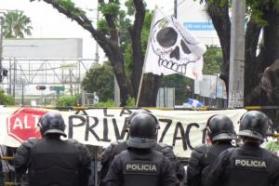
The vendors were the first activists to be accused under theantiterrorism law, but they will not be the last. On July 2, protestersgathered in the town of Suchitoto to oppose President Saca's plan to"decentralize" the country's water systems, which many believe is thefirst step toward privatization. As government helicopters swirled inthe sky, protesters blockaded the street, preventing Saca's caravan fromentering the city. Riot police and PNC agents opened fire with tear gasand rubber bullets, and arrested thirteen people, including four leadersof the rural development organization CRIPDES, as well as journalistMaría Haydee Chicas. Thirteen of those arrested are being chargedunder the antiterrorism law.
María Silvia Guillén, executive director in ElSalvador of the Foundation for Studies of Applied Law, believes the lawis being used as a political weapon. It creates "wild cards that allowthe concepts and penalties of the law to be invoked or left aside at anygiven time, influenced by any political motive," shesays. Pedro Juan Hernández, a professor of economics at theUniversity of El Salvador, concurs. "The objective of theseantiterrorist laws isn't to fight terrorism, because there haven't beenacts of terrorism [in El Salvador] in many years," he recently toldIn These Times.
The Bush and Saca administrations maintain close ties. ElSalvador is the only Latin American country with troops still in Iraqand was the first to sign the Central American Free Trade Agreement(CAFTA). The country receives $461 million over five years in US aidthrough the Millennium Challenge Corporation and is home to thecontroversial US-run International Law Enforcement Academy (ILEA) in SanSalvador.
Despite ample evidence of abuses, US officials have failed tocondemn violations of civil liberties in El Salvador. "Whateverstep a government takes against terrorism is an appropriate step,"said Ambassador Barclay after El Salvador's antiterrorism lawsqueezed through Congress last year. He also made news when he urged theSalvadoran government to step up its use of wiretaps. Current USAmbassador Charles Glazer has remained silent on the issue and declinedto go on record for this article.
US economic interests run deep in El Salvador. After the 1996privatization of the country's electricity industry, corporations likeNorth Carolina-based giant Duke Energy, once a business partner withEnron, swooped in to invest. If El Salvador's water infrastructureis privatized, analysts predict, a similar assault will follow; in Maythe Overseas Private Investment Corporation, an agency ofthe US government, held a conference in San Salvador focusing on"investment opportunities in sectors such as infrastructure[and] energy." CAFTA also streamlines the privatization process andprioritizes strengthening intellectual property laws andpunishments, and the ILEA's founding charter establishes intellectualproperty rights as a prime concern. Elsewhere, the ILEA has said itsmission is to "enhance the functioning of free markets." The vendors,however, say that repression has increased since CAFTA and the ILEA cameto El Salvador.
Wilfredo Berrios, a labor leader in San Salvador, argues that therecent crackdown is designed to silence protest against Saca's economicpolicies and to protect the investment climate for foreign businesses."The opposition to CAFTA and to water privatization has been verystrong," Berrios says. "These policies can't go forward unless theiropponents are silenced."
Opponents of the new law now include three judges from the SanSalvador tribunals, who recently criticized the measure for beingtoo vague. In August forty-one US Congress members sent a letter toPresident Saca expressing concern over the arrest of Suchitotoprotesters. On September 1 the government dropped all charges againstthe vendors. But the thirteen people arrested in Suchitoto, includingHaydee Chicas, still face terrorism charges and will stand trial inFebruary. If convicted, they could face up to sixty years in prison.
While it has offered rhetorical support for the antiterrorismlaw, the Bush Administration remains cautious about moredirect intervention. After all, US involvement in the country'saffairs--like the massacre at El Mozote, where US-trained soldiersraped, tortured and executed 900 villagers in 1981--has causeddiplomatic disasters in the past. But like Ambassadors Barclay andGlazer, Washington remains quietly supportive of repression in ElSalvador, continuing to deepen and benefit from economic and militaryties with the Saca administration.
If the United States has learned to be more hands-off in itsrelations with El Salvador, President Saca draws a very differentlesson from history. In a May 7 speech, he offered an example fortoday's armed forces to emulate in the "war on terror": Col. DomingoMonterrosa, the commander who led the massacre at El Mozote. "ColonelMonterrosa," Saca said without irony, "knew how to defend the nation,with nobility, in the saddest moment of the Republic."
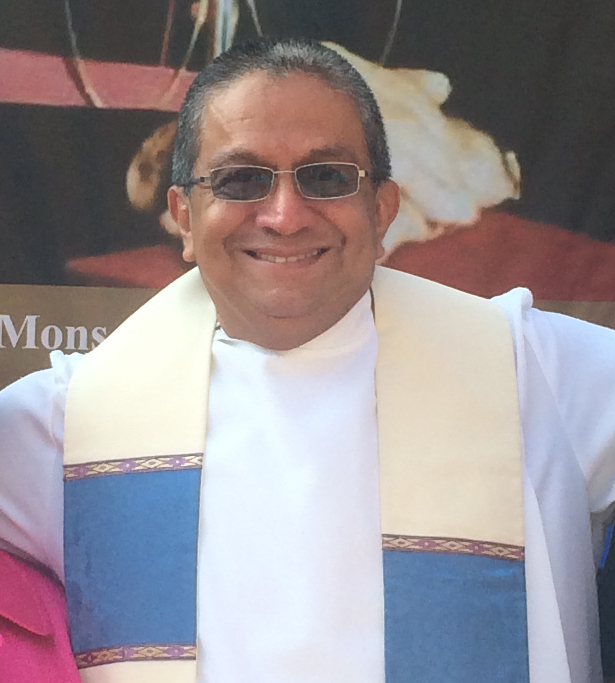 "I am a CISPES supporter because continuing to fight for social justice and a more people-centered country means continuing the dream and sacrifice of thousands of my fellow Salvadorans who died for that vision.” - Padre Carlos, New York City