Judge jails environmentalist attorney and cooperative leader
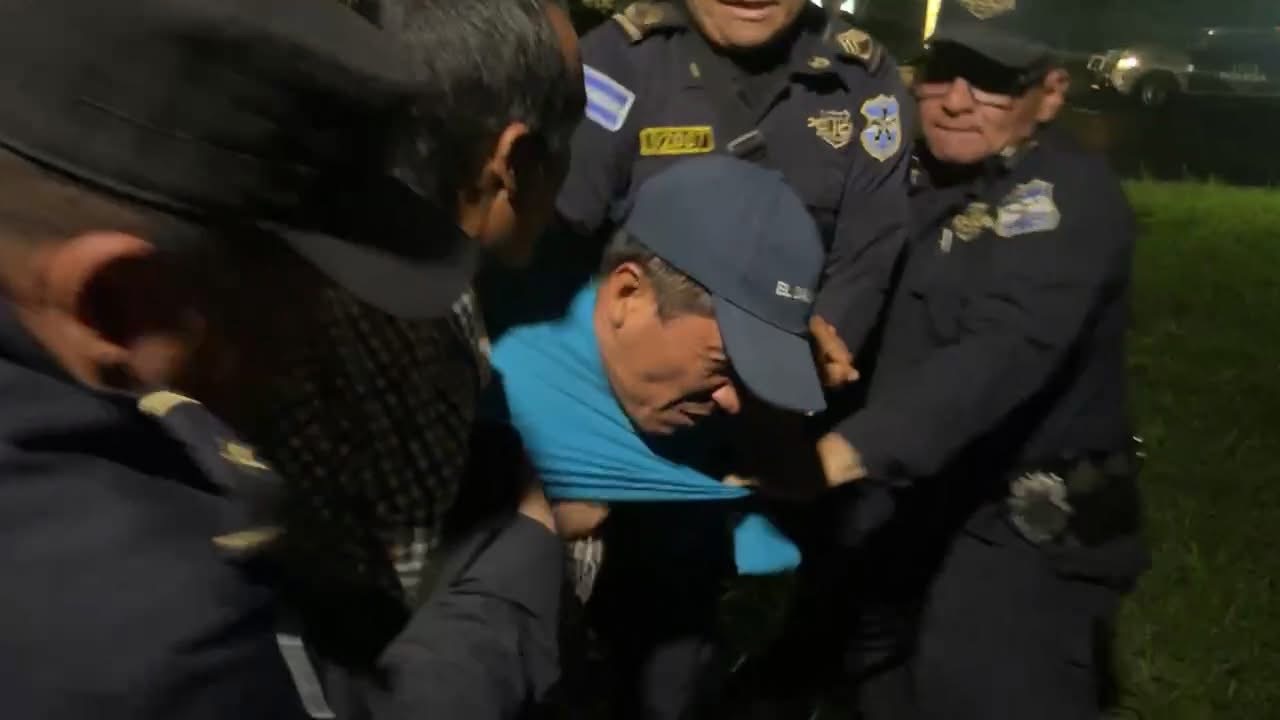
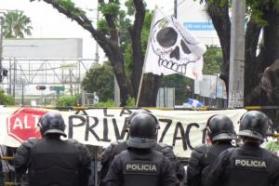
In an acceleration of the Bukele regime's crackdown on dissent in El Salvador, on May 30 a judge allowed criminal charges against lawyer and environmentalist Alejandro Henríquez and pastor and cooperative leader Don José Ángel Perez to move forward. Both had been part of a peaceful vigil on May 12 calling on President Bukele to intercede in the face of an eviction order that would affect 300 families in the agricultural community of El Bosque. Members of the riot police, military police and National Civilian Police violently repressed the vigil, including children and elders, and videos of the repression have led to public outcry in El Salvador. Police arrested José Ángel the night of the vigil; Alejandro was arrested the next morning at his office.
 Over 100 organizations from 20 countries decried the arrests and called for "an end to the current wave of land expropriations faced by cooperatives that were beneficiaries from the land reforms of the 1980s, the permanent suspension of human rights under the State of Exception and to the criminalization of land and water defenders."
The two were held incommunicado for 15 days before the preliminary hearing, which took place on May 30. Rather than abide by the maximum 72 hours of administrative detention the law allows before charges are presented, the state applied the parameters of the State of Exception, which extends this period to 15 days, as if the defendants were suspected gang members. This has become the custom in recent months as community leaders and human rights defenders have faced an alarming wave of criminal charges.
The Attorney General's office charged Alejandro and José Ángel with public disorder and resisting arrest and announced it would request six months of pre-trial detention, to which the judge quickly agreed.
Upon leaving the courthouse, Jaime Ortega, attorney for José Ángel, gave a powerful statement to the press:
"We’re just now coming out of the hearing. All the evidence was presented to disconnect our clients from any criminal act they were being accused of, which was public disorder and resisting arrest. We clearly explained all the key points. No evidence was presented that could link our clients to that criminal act, because what’s happening is that three basic rights that are protected by the Constitution are being criminalized — the right to free speech, the right to assemble, and the right to dissent. We all have those rights, and they are in the Constitution.
But sadly, without any evidence, the case has now moved to the next stage, with provisional detention for each of the detained despite the many, many, many ties to the community [we presented showing they are not a flight risk]. That is, these are not people who would run from the process; they could have remained involved in it. In fact, the Constitution and the Criminal Code say that if the judge thought the ties weren’t strong enough, they could still have imposed bail. That wasn’t done either.
So this tells me we’re facing an unfair situation, and as a lawyer, I feel powerless. As a citizen, I feel powerless. I wish things were different, but this is where we are, and we just hope and pray to our Lord Jesus Christ for each of them, and for our country — that there may be peace, and that we may have freedom to express ourselves without having to go through such a difficult situation."
When asked about the judge’s reasoning for ordering provisional detention, he replied, "I wouldn’t want to speak much about that, but I think my statement about the many, many, many ties to the community— which I already said we presented — should have been enough to allow for release with alternative measures. But it was exactly the opposite. The Pact of San José says that detention should be the last resort, only when a person doesn’t have enough ties to show they will stay in the process."
When asked if the Attorney General's charges of public disorder and aggressive resistance were upheld, he affirmed that both charges were upheld. "Bur during the process, it was clear that there was no evidence linking them to having committed the act of resistance. The prosecution should have shown, for example, that they blocked traffic, that there were disturbances, that they were carrying weapons — and the only “weapons” the prosecution said they had were a hammock, a stove, and a table where they were eating. I don’t know if those are now considered weapons to kill someone — I don’t know."
///
Popular movement organizations in El Salvador are calling for international denunciations of the recent wave of arrests of human rights defenders and community organizers in El Salvador. Urge your Members of Congress to speak out against this injustice and the recent arrest of prominent attorney Ruth Lopez, head of the Anti-Corruption Unit at Cristosal.
 "I am a CISPES supporter because continuing to fight for social justice and a more people-centered country means continuing the dream and sacrifice of thousands of my fellow Salvadorans who died for that vision.” - Padre Carlos, New York City