CAFTA repercussions in El Salvador
New labor violations in maquila sector, repression of market vendors, and negligible minimum wage increase
In El Salvador, the government-sanctioned labor violations in the maquila factories continue in the shadow of CAFTA, and the labor movement fears an increase in such violations once the implementation of CAFTA is deepened. Since the Salvadoran government's bet is to make the country a source of cheap labor in order to attract foreign investment, and the government does not have the political will nor capacity to ensure core labor standards, labor violations will become even more rampant if more of international capital does in fact arrive. For the time being, the governing ARENA party continues to guarantee poverty wages and union-busting tactics for the maquila industry in particular, and for Salvadoran society as a whole.
Two events signify grave times ahead for women working in maquilas. First, in early August about 400 women who work in the maquila Quality S.A. de C.V. took over their factory when the maquila owner attempted to relocate the workers from San Salvador to Santa Ana, a little more than an hour away. The minimum wage in Santa Ana is lower, the workers would have to travel more than two hours a day, and they are already regularly forced to work overtime. Even worse, working in another maquila under a different name would allow the company to default on the workers' years of earned benefits. The women have taken direct action to block the maquila owner's attempts to take out company machinery and are committed to maintaining the takeover until they are allowed to resume work in San Salvador or are given severance pay according to the law.
Meanwhile, workers from the Hermosa factory - a maquila that manufactured clothing for Reebok and Adidas - are preparing for their upcoming court hearing on Friday, September 1st against the maquila owner, Montalvo Machado. The workers have been fighting for more than a year now both in the streets and in lengthy legal cases ridden with corruption and government complicity of labor violations. More than 600 workers, most of which had worked there for more than 10 years, were left without work, severance pay and years of earned benefits when Machado closed Hermosa in 2004 and set up a new shop under a different name. The illegally fired workers then unionized under harsh conditions. The upcoming September 1 hearing in the case against Montalvo is one of the few remaining cases open and the workers are calling for international solidarity in the form of political pressure on the government of El Salvador to comply with the law and respect workers' rights.
Police continues to harass informal vendors as consequence of CAFTA
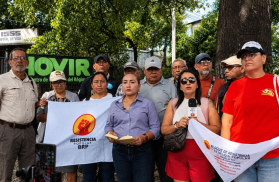
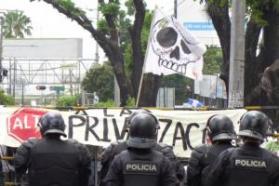
The Movement of Vendors of CD-DVD's and other Brand-name products (informal vendors) held a press conference today to denounce continued intimidation tactics by the National Civilian Police (PNC). The last couple of weeks have seen increased captures of vendors and confiscation of their merchandise under a new justification: that the vendors reproduce child pornography. The Movement has immediately and categorically distanced itself from the sale of pornography, and has charged that the increase in pornography displayed at some vendors' stalls is the product of an effort to delegitimize their struggle. "After 4 months of CAFTA coming into effect, the US Chamber of Commerce is breathing down the Salvadoran government's neck to apply the Intellectual Property Chapter, with its corresponding penal and procedural reforms, against those of us that sell CD's and DVD's and against those who produce CD-DVD's so that we have no merchandise," reads the Movements' latest communiqu
 "I am a CISPES supporter because continuing to fight for social justice and a more people-centered country means continuing the dream and sacrifice of thousands of my fellow Salvadorans who died for that vision.” - Padre Carlos, New York City