U.S. Ratchets up Intervention as Elections Approach in El Salvador, CISPES Gears up to Respond
Anti-terrorism law, police repression, electoral manipulation part of U.S. attack on Salvadoran democracy
by Cameron Herrington, Seattle CISPES
The past two years in El Salvador have been marked by increasedresistance and organizing in the face of the failed economic and socialpolicies of the right-wing ARENA party and its principal backer, theBush Administration. In its solidarity work with social organizationsand progressive political forces in El Salvador, CISPES has witnessedthe Salvadoran and U.S. governments repressive response to this growthin opposition political activity, and we have provided political andmaterial support to those who are being targeted and repressed.
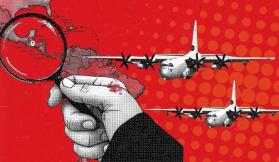
In the shadow of the 2006 implementation of CAFTA the Central American Free Trade Agreement the U.S. State Department began training El Salvadors police at the International Law Enforcement Academy (ILEA), located just outside of San Salvador. El Salvadors National Civilian Police (PNC) has, in the intervening two years, become an increasingly repressive and politicized institution. Armed with the Special Law Against Acts of Terrorism, the PNC has been regularly used to silence dissent and violently confront protesters. Politically motivated crimes including the assassinations of social, religious and opposition political leaders routinely go uninvestigated.
As monumental elections approach in El Salvador, scheduled for January and March of 2009, we expect that the repressive behavior of the Salvadoran government will only increase. We also expect the United States to intervene in the elections on behalf of ARENA, as has happened in the past. In the face of these threats, CISPES is preparing to confront U.S. intervention and the repressive ARENA government that this intervention is meant to support.
Invoking terror to close the door on democratic change
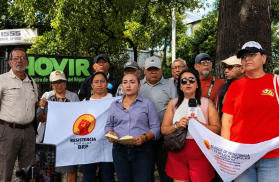
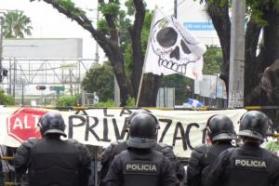
On February 8, after months of relentless international and domestic pressure, charges of acts of terrorism were dismissed for 13 activists and community leaders who had been arrested at a demonstration against a government water privatization scheme last summer in the town of Suchitoto (see related article on pg. 2). Though this case is far from an isolated incidence of overzealous law enforcement, the violent, illegal repression of the Suchitoto protestors and subsequent terrorism charges are widely viewed as the worst human rights abuses since the end of the civil war in 1992.
Continuing a decades-long pattern, the role of the United States in supporting this most recent attack on Salvadoran democracy is unambiguous:
The law that gave rise to the terrorism charges, 2006s Special Law Against Acts of Terrorism, is modeled on the USA PATRIOT ACT and was heralded by then U.S. Ambassador Barclay, who celebrated El Salvadors ascension to the status of partner in the war on terror.
El Salvadors increasingly corrupt and repressive National Civilian Police (PNC) is lauded by the U.S. State Department as an outstanding institution that should serve as an example for all of Latin America .
Members of the PNC receive special counter-terrorism training at the U.S.-run ILEA in San Salvador.
The Salvadoran military, which now routinely violates a fundamental principal of the 1992 Peace Accords by participating in domestic law enforcement and took part in the Suchitoto repression continues to be trained at the U.S. Armys Western Hemisphere Institute for Security Cooperation (WHINSEC, formerly the School of the Americas) at Ft. Benning, Georgia.
Unfortunately, the Suchitoto case is far from unique in its invocation of the U.S.-led war on terror for the purpose of suppressing legitimate democratic participation. Despite the Bush administrations rhetoric about promoting democracy, real world evidence demonstrates that the war on terror has gone to considerable lengths to stop freedom and democracy dead in its tracks. While this is clearly the case in the U.S. with warrantless wiretapping, spying on peace activists, and the PATRIOT ACT representing dangerous incursions on basic democratic rights it is perhaps even more blatant in oft-overlooked corners of the world. In El Salvador, 16 years after the end of the U.S.-sponsored civil war, a once-hopeful democratic opening has been perilously narrowed, in part by the logic of the war on terror.
Electoral intervention
In addition to its support for the Salvadoran governments crackdown on political dissent, it seems certain, based on past experience, that the U.S. government will directly intervene in El Salvadors 2009 elections. In fact, Salvadoran President Tony Saca has already publicly called for such intervention. Furthermore, it is probable that this intervention will exploit El Salvadors economic dependence upon immigrants living the United States as part of the right-wing ARENA partys fear-based campaign.
It is estimated that over a quarter of El Salvadors families directly rely upon relatives in the United States to provide for their basic needs through remittances. In reality, the entire economy would collapse without the 2-3 billion dollars that immigrants send back to El Salvador every year. As a result, any threats to this source of survival, no matter how dubious, carry a lot of weight in Salvadoran electoral politics.
The majority of Salvadorans living in the United States are either undocumented living and working in constant jeopardy of detention and deportation or in the U.S. through a special Temporary Protected Status (TPS) granted by the Department of Homeland Security. In both cases, these immigrants ability to remain in the U.S. is highly tenuous and depends upon the continued good graces of the U.S. government a reality of which Salvadoran families are all too well aware. The Bush administration and right-wing members of Congress have exploited this dynamic to help sway El Salvadors last two elections.
In the lead-up to 2004s Salvadoran presidential election, Representatives Tom Tancrado (R-CO), Dan Burton (R-IN), and Dana Rohrabacher (R-CA) issued a threat: if the leftist FMLN party were to win the presidency, it could mean a radical change in United States policy as it pertains to the essentially free-flow of remittances from Salvadorans living in the United States to El Salvador." This threatened blackmail against the Salvadoran people, widely reported in the Salvadoran media, would have crippled El Salvadors economy overnight if it were carried out. U.S. State Department officials in Washington and at the embassy in San Salvador contributed ominous warnings about the U.S.s inability to cooperate with an FMLN government. In a country that depends upon friendly relations with the U.S., these threats played an important role in ARENAs electoral victory in 2004.
Just weeks before the 2006 legislative and municipal elections, President Saca flew to Washington for a high-profile, meeting/photo op with President Bush where it was announced that TPS status for Salvadorans living the U.S. would be renewed, thanks to the special relationship between the U.S. and Salvadoran governments. Front page photos of the two leaders shaking hands were provided ARENA with invaluable campaign propaganda, again based upon the myth that the right-wing partys hold of the government was the only thing preventing hundreds of thousands of Salvadorans from being deported from the U.S. TPS is scheduled to expire again in March 2009, which coincidentally is the same month that El Salvador holds presidential elections.
With the Bush administration in lame-duck mode, and with attention on the U.S. elections lessening Congressional oversight, it can be expected that U.S. intervention in El Salvadors campaign will again take place.
Just as CISPES has mobilized to resist U.S.-backed repression and attacks on Salvadoran democracy, we are now gearing up to confront electoral intervention. We will seek and publicize pledges of non-intervention from members of Congress, organize delegations to El Salvador, and explore creative ways to use media in the U.S. and El Salvador to dispel myths and threats propagated by U.S. and Salvadoran officials. The Salvadoran people have worked for decades to build true, grassroots democracy. At this critical juncture, with historic elections on the horizon, CISPES will do all it can to ensure that the voice of the Salvadoran people is heard, free from manipulation and intervention by the U.S. government.
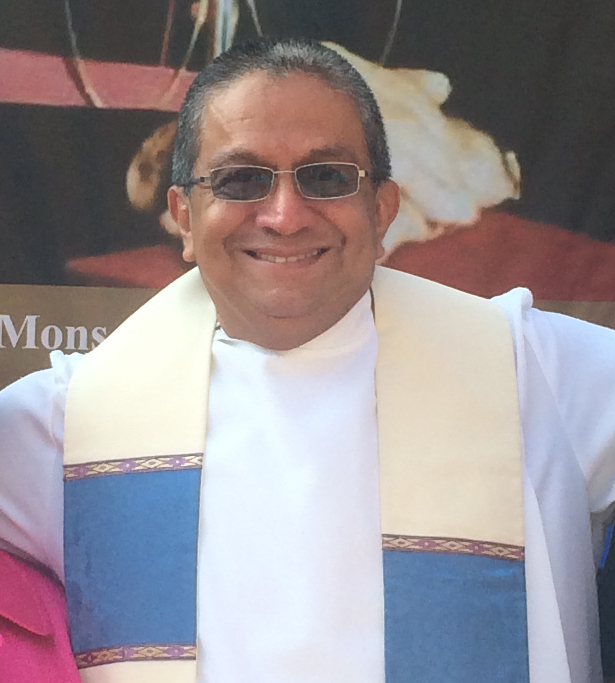 "I am a CISPES supporter because continuing to fight for social justice and a more people-centered country means continuing the dream and sacrifice of thousands of my fellow Salvadorans who died for that vision.” - Padre Carlos, New York City