Operation Disrupt Democracy in El Salvador
from the January edition of Zmagazine
Internationalobservers have denounced recent activities of the U.S. Agency forInternational Development (USAID) and the National Endowment forDemocracy (NED) as designed to overthrow democratically electedpresidents Evo Morales of Bolivia and Hugo Chavez of Venezuela. Asimilar strategy is underway to undermine the electoral process in ElSalvador by striking fear and confusion into voters before legislativeand presidential elections in 2009.
SinceNovember 2007, El Salvador's leftist party, the FMLN (Farabundo MartíNational Liberation Front), has been consistently polling at a 12-14point advantage for upcoming legislative, municipal, and presidentialelectionsahead of the right-wing ARENA (National Republican Alliance)party's presidential candidate and former national civilian policedirector, Rodrigo Avila, who has peaked at around 38 percent byconservative estimates.
Because an FMLN victory could deal a profoundloss to Washington and Wall Street by countering attempts to increasethe corporate privatization of land and public services, business mediaand government officials have stepped up attempts to defeat them in thepress and behind the scenes.
Ina recent address to the American Enterprise Institute, SalvadoranForeign Minister Marisol Argueta implored the U.S. government tointervene in the elections on ARENA's behalf. In addition,international press reports have propagated ridiculous claims of amounting "terrorist conspiracy" between the FMLN, the FARC in Colombia,and Hugo Chavez. Wall Street Journal editor Mary AnastasíaO'Grady has complained that if the FMLN wins, foreign investors willsuffer. Indeed, several countries that participated in the 18thIBERO-American Summit in October agreed that corporate privatizationhas failed the majority of people in Latin America. Presidents inBrazil, Argentina, Bolivia, Venezuela, Ecuador, Paraguay, and Guatemalaare proposing increased regulation and oversight of corporateexpansion. An FMLN victory in El Salvador promises further movement inthis direction.
FMLNcandidate Mauricio Funes has said that an FMLN administration wouldwork to oppose biofuel production and the current profit structure formining projects in favor of spurring agricultural development. "We haveto improve agricultural production. Over the past 19 years of ARENAgovernment, the infrastructure for food production has been neglectedand dismantled. It is essential and a priority to allot land use forfood production and the harvesting of vegetables and staple grains.This is what the people need. We cannot allow ourselves the luxury ofallotting areas of land for biofuel production because we are not goingto work to feed machines; we have to work to feed human beings."
In itsattempt to confuse and ultimately sabotage the FMLN's campaign,right-wing Venezuelan-based pro-U.S. media organization FuerzaSolidaria has released a set of television ads and door-to-doorleaflets that assail potential voters with the usual dose ofmisinformation and scare tactics that accompany every electoralcampaign in El Salvador. Designed to suppress votes for the FMLN, oneof the ads portrays Funes and the FMLN party as an out-of-touch,antiquated relic rather than a political manifestation of theSalvadoran peoples' historic, and ongoing, broad-based resistance toforeign exploitation. Simplistic "flow chart" arrows on the ad implythat an FMLN-led government would sacrifice remittance money from theU.S. to be a puppet for Chavez's "anti-American expansion project." Theintended message is clear and has been the preferred threat of theimmigrant-bashing Bush administration to Salvadorans on both sides ofthe border: those who support the FMLN are against the U.S. If the FMLNwins the election, Immigrations and Customs Enforcement (ICE) willbegin massively deporting Salvadorans and the U.S. will cut offremittances.
USAID, NED, and Fuerza Solidariawith the helpof corporate-owned media and the U.S. governmenthave been a majormotor behind anti-democratic political strategies in Venezuela andBolivia since 2001. In April 2002, the United States utilized the NEDto channel funds to private organizations that were running covertpropaganda campaigns in support of a failed coup in Venezuela, whichdetained President Chavez and recognized the short-lived, pro-U.S.government. According to the New York Times, the NED"funneled more than $877,000 into Venezuelan opposition groups in theweeks and months before the unsuccessful coup attempt."
In the wakeof the failed coup, the NED channeled another $53,400 to help create aU.S. backed organization called Sumate, a group designed to unite,strengthen, and mobilize opposition to the popularly elected Chavezgovernment, and which supported Sumate's efforts to disseminatedisinformation. In 2004 the group published fake exit polls thatclaimed Chavez lost the referendum recall vote. While their strategieshave mostly failed, the actions of Sumate and NED have effectively castdoubt on the legitimacy and democratic goals of the Chavez government,weakening its image internationally.
In Bolivia,investigative journalists Jeremy Bigwood and Benjamin Dangl's inquiriesthrough the Freedom of Information Act and one-on-one interviews showedthat the former U.S. embassy therethrough USAID and NEDhad maintainedclose relationships with right-wing opposition groups to "promotedemocracy" by undermining President Morales as well. Through theseconnections and a USAID Political Party Reform Project, the U.S. hassupported forces that could "serve as a counterweight" to Morales's MAS(Movement Toward Socialism) party. In response, Morales recently kickedthe U.S. ambassador out of Bolivia. USAID and Fuerza Solidaria werealso exposed for their attempts to influence Bolivia's referendum inAugust 2008.
In November 2007, another NED recipient, theInternational Republican Institute (IRI), presented SalvadoranPresident Tony Saca of the ARENA party with the "Freedom Award" forpromoting U.S. values in El Salvador such as "linking economic growthwith democratic governance and vigorously defending freedom at home andabroad." Never mind the re-emergence of death squads, unsuccessfulattempts to convict protestors and vendors as "terrorists," and anunprecedented post-war increase in Salvadoran migration to, anddeportations from, the U.S. during his term. This exercise in eliteback-patting not only unveils the biases of the IRI, which is chairedby Republican Senator John McCain, but also underscores the U.S.government's explicit endorsement of the right-wing ARENA party,another act of intervention and electoral manipulation.
In January2008 U.S.-based CISPES (Committee in Solidarity with the People of ElSalvador) received a familiar warning from the Department of Justiceaccusing the group of "acting as a foreign agent" of the FMLN party,presumably as backlash for its political connections with the leftistsocial movement in El Salvador. An identical letter 14 years agosignaled the beginning of a massive three-year FBI infiltration projectaimed at destroying the organization. When asked to name CISPES's"conspiratorial allies" past and present, Executive Director BurkeStansbury responded: "People and popular movements organized tochallenge U.S. sponsored political, economic, and electoral violenceare the ones that get our attention and our commitments. Our governmenthas designed and rewarded the brutal repression of countless uprisingsin El Salvador, and is still very active in this way." Is the FMLN aCISPES ally? "Absolutely. We have always maintained politicalsolidarity with the FMLN and will continue to do so. What is more, weare committed in every way to challenging U.S. attempts to deny ElSalvador its basic rights as a sovereign country. Elections are onlythe tip of the iceberg."
In June theU.S. ambassador to El Salvador, Charles Glazer, told a CISPESdelegation that the U.S. government's days of interfering in ElSalvador's elections are over. He said that although they did intervenein the 2004 presidential election, they would not do so again in 2009.His aide then explained that the delegation "wouldn't have to worryabout fraud this time because the NDI and IRI will be training[Salvadorans] how to conduct a quick count." One has to wonder what theembassy's definition of intervention is.
To make theU.S. government and ARENA party alliance even more transparent,Ambassador Glazer appeared publicly in early November with the outgoingSalvadoran president at the Ronald Reagan Building in Washington, DC.President Saca was on the campaign trail againwith Salvadoran taxpayermoneyto raise the profile of ARENA with the ironically titled "Peaceand Prosperity" conference. Glazer was at his side, ready to fieldquestions and concerns.
There is nodoubt that major changes underfoot in the Latin American region haveput Washington on edge. Country after country is electing governmentswho represent the majority of people instead of the financial interestsof a few. El Salvador's left appears destined for both an historicvictory at the polls and a new phase of struggle against U.S.dominance, as USAID and NED have become the faltering empire's new"diplomatic weapons" of choice.
Z
Erica Thompson works with CISPES in San Salvador.
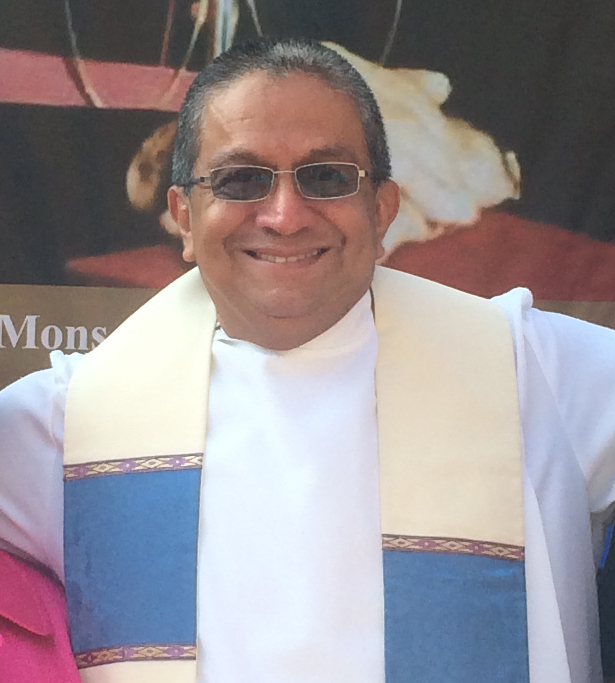 "I am a CISPES supporter because continuing to fight for social justice and a more people-centered country means continuing the dream and sacrifice of thousands of my fellow Salvadorans who died for that vision.” - Padre Carlos, New York City