Update: Funes and Obama, Historic First Meeting at the White House
also in this update:
* Funes Administration Unveils New Security Plans
* U.S. Clamors for Influence in Salvadoran Security Policies
* President Lula Visits El Salvador
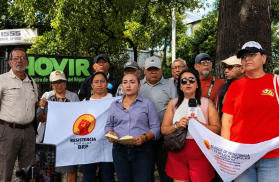
On Monday, March 8 President Mauricio Funes met for the first time with his U.S. counterpart in Washington, DC. The two heads of state spoke behind closed doors for an hour before making a joint public statement from the White House. Their discussion focused primarily on immigration policy, regional security and El Salvador’s economy. This meeting was seen as an important step in rejecting the notion publicized by the Salvadoran right-wing that Funes – the first president of the leftist party Farabundo Martí Front for National Liberation (FMLN) – would be unable to maintain good diplomatic relations with the U.S., thereby jeopardizing the lives of the Salvadorans living in the U.S. and the millions of dollars of remittances sent to support family members in El Salvador.
Immigration has been the highest foreign policy priority of President Funes, given the 2 million plus Salvadorans who reside in the U.S. In his remarks Funes outlined the relationship that El Salvador’s economy has to the U.S. immigration issue, stating that El Salvador “needs to generate work opportunities in order to be able to keep people back in El Salvador. And as they have better job generation, and people have better health and education, people will be able to remain in countries and have a better life.” The Salvadoran president also made a specific request for Obama to extend the Temporary Protected Status (TPS) by an additional 15 months, currently due to expire in September 2010. TPS has provided temporary legal residency to over 200,000 Salvadorans living in the U.S.; it has also consistently been used by prior U.S. administrations as a political tool to boost the right-wing Nationalist Republican Alliance (ARENA) party during electoral campaigns in El Salvador.
On the topic of security in Central America, the two presidents concurred that poverty, marginalization, and social exclusion are the root causes of regional drug trafficking and organized crime. Obama remarked that, “The security challenges obviously are connected to the economic challenges within the region and we want to be supportive not only in addressing the symptoms that we see in terms of crime, but also the root causes.” Although these comments represent a break from previous U.S. and Salvadoran presidents who often addressed regional crime without contextualizing the issue as entrenched within economic realities, no changes were discussed with respect to the repressive policing strategies and policies currently employed by the U.S. in Central America.
Funes Administration Unveils New Security Plans
In late February, President Funes and the Minister of Public Security Manuel Melgar revealed new policies and initiatives to address the country’s high levels of violence and crime, the legacy of widespread poverty and institutional impunity fostered by decades of right-wing party governance. At the close of 2009, El Salvador led the hemisphere in homicides per capita and the alarming trend has continued into 2010. Among the new security policies are a number of changes designed to strengthen the National Civilian Police (PNC), a notoriously under-equipped body, severely lacking the capacity and training to investigate crimes effectively. As of March 15, 66% of the PNC will be housed in barracks provided by the Armed Forces where agents will receive meals and transportation to their assignments – important employment benefits that will decrease officers’ susceptibility to corruption. Additionally, basic police resources like patrol cars, radios, bullet-proof vests, firearms, and computers are to be purchased for the PNC, along with more training in forensic investigative techniques for agents.
The “Zero Corruption” plan will strengthen the investigative capacity of the PNC’s independent Inspector General – the institution charged with prosecuting high and low-ranking police officials for corruption – which has been recently revitalized by newly-appointed director Zaira Navas. The government also plans to implement the successful model used to convert the Distrito Italia neighborhood in Tonacatepeque municipality from one of the most violent areas to a homicide-free zone for the past three months. The initiative takes a holistic approach to crime and violence reduction, incorporating neighborhood clean-ups and social programs such as sports activities for youth, with a heightened law enforcement presence in the community.
Violence and crime are deeply political issues in El Salvador; it is the country’s poor communities that bear the brunt of high murder, assault, and extortion rates. In recognition of this reality, the Funes Administration’s new security policies are designed to complement the government’s social investment projects, such as the “House for All” and the student uniform programs. El Salvador’s Human Rights Ombudsman, the country’s Catholic Archbishop, and numerous foreign diplomats have lauded the new security initiatives. To date, the government has procured $28.4 million of the $80 million required to implement the new plans.
U.S. Clamors for Influence in Salvadoran Security Policies
Several of El Salvador’s new security initiatives received swift offers of aid from the United States government, augmenting its already large security and military influence and presence in El Salvador. Following the Legislative Assembly decision to create a Call Monitoring Center for court-ordered phone taps to investigate murder, extortion, and kidnapping cases, the U.S. offered $1 million for the center’s construction, equipment, and personnel training. In late February, the National Council on Public Security (CNSP) announced plans to install Municipal Violence Observatories that will be operated by local governments in municipalities with the highest crime rates. These observatories will provide detailed statistics on crimes committed within the municipalities and be used by both the Ministry of Security and the municipal government to implement prevention programs and other security policies, as well as adjust existing ones. The U.S. government announced that it would also assist in equipping these new observatories.
The Salvadoran State’s stretched financial situation, coupled with the population’s insistent demands for relief from crime and violence, require the government to look to foreign contributors to fund its security programs. The U.S. government maintains its historical interest and involvement in regional security policy, readily funding initiatives pertaining to intelligence gathering and crime repression – such as the new Call Monitoring Center, the municipal observatories – as opposed to crime prevention programs. El Salvador is also part of the Mérida Initiative, a $1.6 billion U.S. anti-drug initiative to combat narcotrafficking throughout Mexico and Central America.
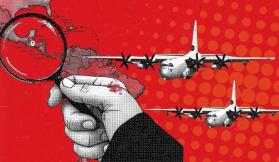
In addition to being the principal foreign contributor of security aid to the country, the U.S. maintains its own array of U.S. military and law enforcement outposts in El Salvador: a U.S. military base near the Comalapa Airport, offices of both the Federal Bureau of Investigation and the Drug Enforcement Agency, and the International Law Enforcement Academy (ILEA), a U.S.-funded facility to train police from El Salvador and other Latin American countries.
President Lula Visits El Salvador
Brazilian President Luiz Inácio Lula da Silva made an official visit to El Salvador on February 26, 2010. The purpose of the visit was to sign conventions between Brazil and El Salvador in areas including public health, public transport, agriculture, and technology. Some of the El Salvador-Brazil cooperation projects include Brazilian technical support for the Ministry of Agriculture to reactivate this previously neglected sector; aid and expertise to the Ministry of Health to improve the country’s blood banking system; and assistance and credit in overhauling the country’s public transport system. Brazil is offering $500 million in credit to El Salvador of which over $300 million will be used to renew the country’s dilapidated bus fleet, with the remaining funding destined to social programs.
During the campaign, Funes cited Lula and Obama as the principal models for his presidency. Given the country’s economic dependence on the U.S. for imports, exports, technical assistance, and aid, El Salvador’s increased cooperation with other regional partners has been a priority of the new administration. Since taking office, the new government has opened relationships with Cuba, Vietnam, and China, opening up El Salvador’s international relations in marked contrast to the ideologically constrained diplomacy of past Salvadoran presidents.
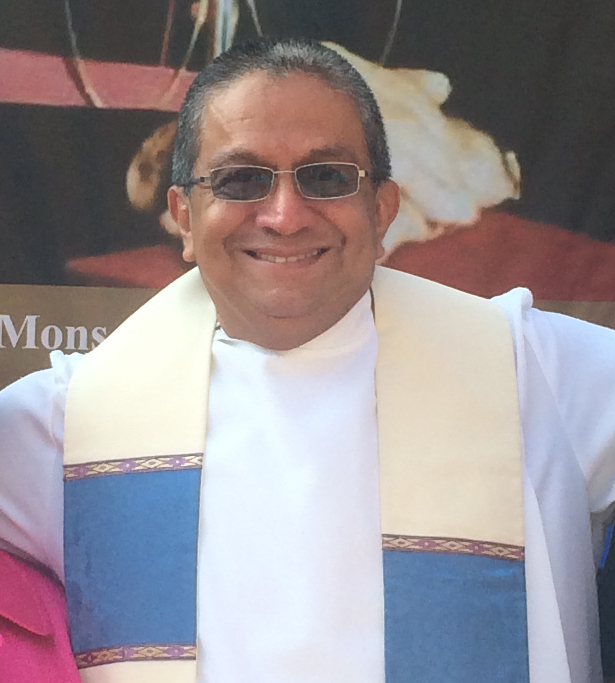 "I am a CISPES supporter because continuing to fight for social justice and a more people-centered country means continuing the dream and sacrifice of thousands of my fellow Salvadorans who died for that vision.” - Padre Carlos, New York City