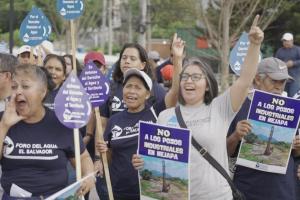
The participation of various sectors of the population,
including peasants, students, women, professionals, unionists, and FMLN party
members, made the march a historic one. Thousands of people peacefully walked
through the streets until arriving in the Civic Plaza, where the march culminated with a
political and cultural celebration featuring speeches by Mauricio Funes and
Salvador Sánchez Cerén, the FMLN’s presidential and vice-presidential
candidates, respectively.
The message of the assembled organizations, and of the
FMLN’s candidates, focused on the high cost of living and the central
government’s ineptitude in implementing any means of alleviating the economic
crisis faced by the Salvadoran population. According to Benito Lara, an FMLN
deputy to the Legislative Assembly, the march was “a rejection of the economic
crisis, which is the product of the failure of the neoliberal
model.”
At the same time, the social organizations – joined by
the FMLN – rejected ineffective, facade-like measures taken by Salvadoran
Presidenet Antonio Saca, including the creation of the Economic Commission,
which is similar the failed Security Commission that was created last year. The
Security Commission made numerous recommendations to the government which have
yet to be acted upon.
“The government manipulates the discussion to the point
that everything appears under control, but the working class continues being
marginalized, with salaries hitting the floor and the cost of food on the rise,”
said Rufino Quesada, march participant and Chancellor of the National University
of El Salvador.
Social sectors criticize government’s
ineffectiveness in face of economic crisis
On Monday, April 28, President Saca delivered a 9-page
speech on the national networks outlining the government’s 8 measures to
alleviate the economic crisis facing El Salvador. The majority of the announced policies
have already been proposed as components of previous government initiatives,
including the much criticized “Alliance for the Family” and “Solidarity
Network.” In response, several international officials, as well as economists,
judged Saca’s proposals to be sterile and ineffective. William Pleytez,
representative of the United Nations Development Program (UNDP) in El
Salvador concurred that, “the country
definitely needs more aggressive measures” to alleviate the crisis faced by the
vast majority of the population.
Joining the chorus of criticism, University of El Salvador economist Raúl Moreno
highlighted Saca’s refusal to recognize the failure of the ruling ARENA party’s
economic policies over the past 20 years. Instead, Saca contends that El
Salvador’s economic crisis results only from a
larger global problem. “It is time to stop attributing internal problems of this
country to external phenomena,” Moreno stated.
Additionally, Human Rights Ombudsman Oscar Luna called
upon President Saca to declare a national emergency in response to the high cost
of certain staple food products. Luna emphasized that the government is doing
little to nothing to fight the crisis, and insisted that Saca initiate “other
types of progressive measures so that economic, social, and cultural rights can
be guaranteed.”
ARENA and PCN propose alarming change to Electoral
Code
After pushing reforms to the Electoral Code through the
Legislative Assembly at the end of 2007, including the elimination of the
requirement that all ballots be stamped and signed by poll workers, the
right-wing PCN (National Conciliation Party) and ARENA parties recently proposed
an additional amendment to the same law, which governs El Salvador’s electoral
process. The proposal would affect Article 175, which deals with the ability of
parties to field candidates in coalition. After dramatic public outcry, the PCN
has withdrawn its support for the proposal at this time, though it could be
brought up again at another time.
The proposed reform would permit the votes for one
presidential candidate to be counted toward the total of another, more popular
candidate if the two parties concerned have previously formed an official
coalition.
Such a reform would allow PCN and ARENA, the principal right wing
parties, to combine their candidates’ votes in order to retain the presidency in
the event of a strong showing by the FMLN.
Legislative deputy Elizardo González Lovo, in statements
made to the Salvadoran news website El Faro, argued that the reform is not means
of robbing the election. “If you will notice, this article [175] does not impede
parties from competing separately in the presidential campaign. This affects
what can happen after the end of the voting, when it is time to count votes.
Imagine: the PCN’s candidate receives 600,000 votes and ARENA’s candidate
received 800,000, totaling 1,400,000 votes. The right
wins.”
According to Juan Carlos Sánchez, representative of the
legal organization FESPAD and member of the Citizens’ Action initiative, the
reform “destroys the direct vote, thus violating Article 78 of the Constitution,
which deals with this subject.” In Sanchez’s analysis, the proposed amendment to
the Electoral Code leaves open the possibility that the valid votes for lesser
parties within a coalition would be negotiated away to benefit the party that
received the most votes among those in the coalition. This paves the way for a
deliberate, fraudulent manipulation of the El
Salvador’s electoral
process.
Delmy Valencia, representative of the
Center for Exchange and Solidarity, denounced the proposed reform, stating that
“these are the types of actions that led to the civil war. These are practices
designed to keep one group in power.”
FMLN commemorates the birth of Farabundo
Martí
El
Salvador’s principal opposition
political party, the Farabundo Martí National Liberation Front (FMLN) celebrated
the 115th anniversary of it’s namesake’s birth on Monday, May 5. A public event
honored the historic revolutionary leader at his graveside in San
Salvador.
Farabundo Martí was born on May 5, 1893, in the
municipality of
Teotepeque, Departament of
La Libertad. As a young man, Martí enrolled in the University of El Salvador, where he studied
Jurisprudence and Social Sciences. However, academic pursuits turned out to be a
low priority for the budding leader, who left the university to travel
throughout the region, joining workers and peasants in their struggles wherever
he found them.
After being elected Secretary of the Exterior of the
Central American Communist Party in 1925, Martí returned to El
Salvador to form part of the leadership of the
Regional Federation of Salvadoran Workers. In 1928 he ventured to
Nicaragua, where he fought
under General Augusto Cesar Sandino against the invasion by United
States military forces. In 1930 he again
returned to El
Salvador, this time as a representative of the
International Red Cross. At the same time, Martí became involved in the
Communist Party of El Salvador, and in little time was among is leaders.
At the end of the 1920s, the Salvadoran military
dictatorship expelled Martí from his own country. However, he returned on
February 20, 1931, to help the Communist Party lead the General Insurrectional
Strike. Less than a year later, on February 1, 1932, Agustín Farabundo Martí and
two of his compañeros in the
struggle, Alfonso Luna and Mario Zapata, were shot and killed by operatives of
dictator Maximiliano Martínez.