More U.S. Meddling in El Salvador?
(from In These Times)
By Jacob Wheeler
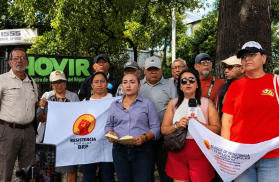
AsEl Salvador prepares to hold its presidential and parliamentaryelections early next year, the Committee in Solidarity with the Peopleof El Salvador (CISPES) worries the Bush administration might bedrumming up fear to sway results.
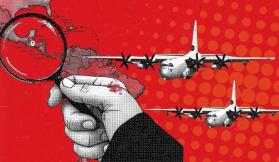
During a June visit to El Salvador, U.S. Deputy Secretary of StateJohn Negroponte expressed concern over alleged links between thepopulist opposition FMLN party Farabundo Mart National LiberationFront and rebels in Colombias FARC Revolutionary Armed Forces ofColombia.
After Colombian troops raided a FARC camp on March 1, the Colombiangovernment alleged it had seized a laptop computer that tied FARC andFMLN. (The FMLN has denied the allegations.)
Any group that collaborates or expresses friendship with the FARCis not a friend of the United States, said U.S. Ambassador to ElSalvador Charles Glazer, echoing Negropontes remarks.
On June 27, Glazer told a delegation of 12 Americans traveling to ElSalvador with CISPES that the United States would not interfere withthe countrys January parliamentary elections and its Marchpresidential elections. However, CISPES alleges that Glazer also saidthat the United States had meddled in El Salvadors 2004 elections.
According to a CISPES press release, When asked directly if theU.S. government had intervened in the 2004 presidential elections onbehalf of the [right-wing] Nationalist Republican Alliance party(ARENA), Glazer replied in the affirmative. When asked if suchintervention would occur again, he said no.
Robert Riley, counsel for public affairs at the U.S. embassy, wrotein an e-mail: Ambassador Glazer acknowledged that certain Americanofficials made public comments in the context of the 2004 Salvadoranelections. However, [Glazer] did not suggest or confirm that theU.S. government intervened in those elections in any way.
According to Riley, Glazer has stated numerous times publicly, theU.S. government will not take sides in the upcoming 2009 Salvadoranelections.
FMLN candidate Mauricio Funes led ARENA candidate Rodrigo Ávila byroughly 6 percentage points, according to a July Reuters poll. If Ávilaloses, it would be the first time since the end of El Salvadors civilwar in 1992 that the conservative ARENA party would be out of power.
The United States has played a nefarious role in Salvadoran history,funding and training the right-wing military and death squads thatmurdered and disappeared 85 percent of the approximately 80,000 victimsduring the countrys 12-year civil war.
In the run-up to El Salvadors 2004 election, Rep. Tom Tancredo(R-Colo.) threatened that the United States would stop Salvadoranimmigrants from sending remittances to their families if the FLMN partywon. Remittances from the United States make up nearly 20 percent of ElSalvadors gross domestic product, and nearly a quarter of allSalvadoran families receive them.
That spring, newspapers reported on fears of remittances drying up,which some say helped tip the outcome to ARENA candidate and mediamogul Antonio Saca, who won 57 percent of the vote to FMLN candidateSchafik Handals 36 percent.
Then-U.S. Ambassador to El Salvador Hugh Douglas Barkley did notrespond to Tancredos threats until after the election, saying that theopinions of members of Congress are independent from the positions ofthe State Department.
The U.S. Embassy in El Salvador never countered this absurd threator clarified the impossibility of such legislation being passed, saysRosa Lozano, a Washington, D.C., delegate who attended the CISPESmeeting with Glazer. Ultimately, such intervention helped turn a closerace for the presidency into a decisive victory for the right-wingARENA party.
To help assuage CISPESs concern about the upcoming elections, theU.S. embassys labor attaché Jami Thompson told the delegation that theInternational Republican Institute (IRI) and the National DemocraticInstitute (NDI) will monitor the races.
But delegation members question the groups objectivity. Last year,the IRI and Sen. John McCain (R-Ariz.) honored President Saca with aFreedom Award, which CISPES says establishes the IRIs bias.
Says Laura Embree-Lowry, a delegate from Boston: The presence ofpartisan groups like the IRI and NDI will be counterproductive to thegoal of the Salvadoran people, which is to hold free and fair electionsin 2009.
Jacob Wheeler is an assistant editor at In These Times.
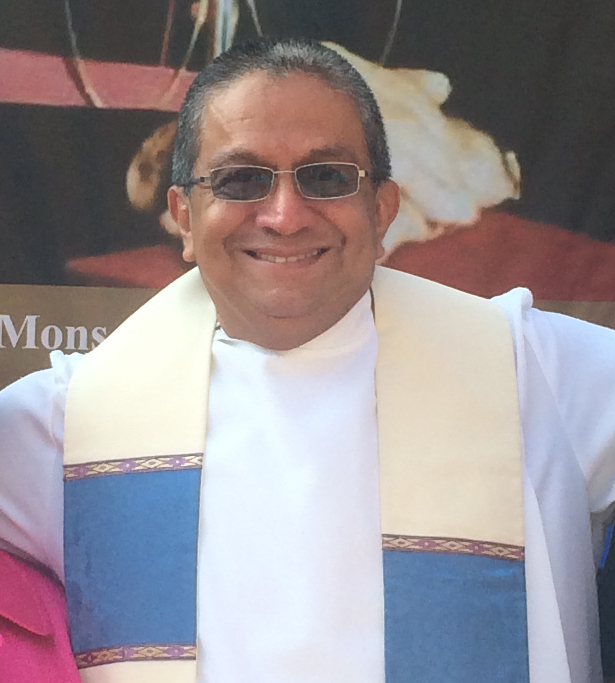 "I am a CISPES supporter because continuing to fight for social justice and a more people-centered country means continuing the dream and sacrifice of thousands of my fellow Salvadorans who died for that vision.” - Padre Carlos, New York City