Anti-mining organizer from San Isidro missing, foul play suspected
Also in this update:
Mining corporationsattack FMLN government
-
FMLN and Mauricio Funesjoin presidents throughout Latin America in denouncing coup in Honduras
-
Funes reports oncorruption
-
FMLN uncovers plan to spyon new administration
-
Funes and his newadministration begin the process of change
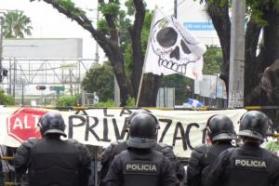
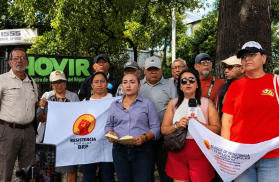
Social movement organizations have denounced the disappearance of Gustavo Marcelo Rivera, a well-known anti-mining organizer from the town of San Isidro, Cabañas. Rivera is a local leader of the FMLN party, the director of the San Isidro Community Center, and the legal representative of Amigos de San Isidro Cabañas (ASIC). He is a vocal opponent of the El Dorado gold mine, a project of the Pacific Rim mining company that has been stalled based on disputes over permits. Pacific Rim recently sued El Salvador for $77 million under the Central America Free Trade Agreement after the government refused to grant a permit to open the El Dorado mine.
Mining corporations attack FMLN government
On March 16, the Commerce Group Corporation and San Sebastian Gold Mines, both U.S.-based companies, filed a Notice of Intent to open legal proceedings against the government of El Salvador in a special tribunal established by the Central America Free Trade Agreement. The companies allege that the government has illegally refused to issue mining permits. The Notice of Intent begins a 90-day period in which El Salvador and the companies can amicably resolve the issue. If the issue is not resolved, Commerce Group and San Sebastian Gold Mines can then sue El Salvador for lost investments. The two companies are demanding $100 million compensation, or the immediate issuance of the mining permits. This is the second demand made against El Salvador under CAFTA laws by mining companies. In April, Pacific Rim Mining demanded approximately $77 million in lost investments from the government. Read more about the Pacific Rim case HERE.
The mining of precious metals in El Salvador is opposed by a broad coalition of social movement groups that make up the National Roundtable on Metallic Mining, which was recently awarded the Letelier-Moffit Human Rights Award by the Institute for Policy Studies in Washington, D.C., for its work resisting mining in the country. The resistance movement contends that the proposed mines would cause major destruction to the already fragile environment in El Salvador and contaminate the few sources of clean drinking water that remain.
The Center for Studies on Investment and Trade (CEICOM) in El Salvador has called on President Mauricio Funes to refuse to pay the Pacific Rim demand. William Castillo of CEICOM’s Board of Directors has encouraged Funes’ administration to work with the social movements opposed to mining and make use of their evidence and arguments against issuing permits in his refusal to pay the demands. “There is sufficient documentation to defeat this demand,” said Castillo.
The FMLN faction in the Legislative Assembly recently introduced legislation to reform El Salvador’s Mining Law by halting all metallic mining exploration and operations and giving companies currently operating in the country six months to close operations. FMLN Legislative Deputy Lourdes Palacios explained that the proposed legislation seeks to “give tools to the new government to avoid mining exploration and exploitation in the country.”
Please stay tuned to CISPES updates and action alerts for news on this important subject and actions you can take to accompany the Salvadoran resistance to mining,
FMLN and Mauricio Funes join presidents throughout Latin America in denouncing coup in Honduras
President Mauricio Funes and the Political Commission of the FMLN both made strong statements denouncing the military coup in Honduras which took place on Sunday, June 28. On Monday Funes travelled with the Secretary General of the Organization of American States Jose Miguel Insulza to Nicaragua where they appeared in a joint press conference. According to Insulza, "There is no room for the military in our region and we will not recognize the force that has brought about this break with the constitution." Meanwhile, FMLN deputy Lorena Peña led a boisterous rally outside the Honduran Embassy in San Salvador calling for the peaceful return of Zelaya to the presidency. Social movement groups in El Salvador are also standing with the people of Honduras, who on Monday were attacked repeatedly by riot police and soldiers as they protested outside of the presidential palace. Dozens of people were injured in the repression, which is being directed by unlawful interim president Roberto Micheletti.
CISPES participated in an action in front of the Honduran Embassy on Monday, while chapters in Seattle, Portland, Los Angeles, New York and San Francisco also led rallies at consulates condemning the coup and calling for the Obama Administration to take stronger action. The Latin America Solidarity Coalition, of which CISPES is a coordinating committee member, is calling on people to make three demands to the White House and State Department: 1) cut off of all US aid (as required by US law) until Zelaya is safely returned to office, 2) Financial sanctions against the coup plotters, and 3) An investigation into what signals U.S. Ambassador to Honduras Hugo Llorens gave to coup plotters before the coup. For more information go to www.cispes.org or www.lasolidarity.org
Funes reports on corruption
On Friday June 12, President Mauricio Funes held a press conference in which he reported on rampant corruption found in many government ministries that he inherited after his June 1 inauguration. Among the examples cited, the National Registry Center was found to have some of the most severe cases, including “ghost positions” and excessive payments to ARENA party functionaries. Over $74,000 dollars were being paid monthly to 29 individuals who were not actually working for the institution. Many of these individuals had worked on ARENA presidential candidate Rodrigo Avila’s campaign. Funes’ press conference also noted many ARENA administration officials who were using multiple state vehicles, in some cases up to 5, for personal use.
Excessive spending that occurred in the months after former President Tony Saca announced a government austerity plan was also brought to light. The government’s Family Secretariat threw a Christmas celebration that cost a half million dollars at a time that public hospital workers were protesting a lack of medication, food, and clean bedding in the hospitals. “There are institutions where the irregularities are frightening, truly frightening, and demand an expedited and systematic investigation that permits us to uncover administrative and criminal responsibilities,” Funes said during the press conference.
FMLN uncovers plan to spy on new administration
In a June 14 press conference, FMLN spokesperson and Legislative Deputy Sigfrido Reyes announced that the Funes administration had uncovered an elaborate plot to spy on the new FMLN government. “It was a far-reaching operation to keep the new government under observation, with cameras, with microphones, with a clandestine apparatus,” explained Reyes. Surveillance equipment was discovered in the Ministry of Governance as well as in other unspecified institutions. Reyes admitted that the FMLN does not know who is responsible for the plot, but assured that the government will carry out an investigation. Reyes did not directly accuse the ARENA party, but called upon its leaders to make a statement. “If this [plot] did originate from the membership of the [ARENA] party, it should be denounced, and [the responsible parties should be] punished,” Reyes declared. ARENA subsequently denied culpability in the matter.
Funes and his new administration begin the process of change
President Mauricio Funes and his executive cabinet have hit the ground running to implement the programs that will allow them to complete their campaign promises. Major policy announcements relating to public health, education, water services, and combating tax evasion were made in the first month of Funes’ administration.
One of the first announcements was the end to “voluntary quotas” in the public health network. These “voluntary quotas” were essentially charges for doctors' visits and other health services that often led people to leave the hospitals without receiving treatment. Additionally, money from the national budget was reallocated for the purchase of essential medicines that the public health system currently does without.
In the Ministry of Education, new policies will guarantee free public education through high school as well as provide free uniforms and school supplies for students. Salvador Sanchez Cerén, Vice-president and Minister of Education, announced a series of education reforms intended to raise a generation of “Salvadorans that can act freely, capable of incorporating themselves into a system with a critical vision of their reality, which will require a high social content [in the educational system].” Sanchez Cerén added, “we must prepare the individual to be an agent of change in society.”
Francisco José Gómez, the new president of the public water distribution company, ANDA, announced that he plans to investigate the Office of Decentralization, which facilitates and encourages the privatization of local water distribution services. “I am reviewing [the subject] because decentralization has not produced any [positive] results. One alarming case that appeared… is in Lolotique [a municipality with decentralized water services], which has gone four months without water.” Gomez explained that he will do away with preferential services for the wealthy, and instead focus on providing water to the poorest communities.
The new administration has also announced the creation of a Vice-ministry of Public Income in order to combat commercial tax evasion in the country. This was a major promise of Funes’ campaign, and is one of the mechanisms the new administration will use to cope with the lack of public funds for social investment. The new Vice-ministry will unite the work of the current Treasury, Customs, and Internal Tax offices, and will coordinate their databases.