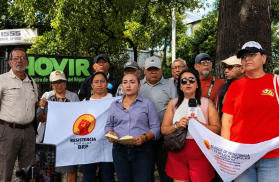
Update: Tropical Storm Agatha Leaves 9 Dead and 8,000 Evacuated
From Friday, May 28 through Monday, May 31 intense rains caused byTropical Storm Agatha dropped over 19 inches of rain, causing flooding,mudslides, killing 9 people and resulting in the evacuation of 8,000people to shelters; the storm took the lives of at least 146 acrossCentral America. On May 29, President Mauricio Funes and the Directorof Civil Protection Jorge Meléndez declared a Red Alert and NationalState of Emergency. With the Red Alert, Civil Protection begancoordinating with local Civil Protection Committees that have beenformed in zones at high risk of disasters to begin evacuatingresidents. Throughout Agatha, President Funes, Meléndez and othergovernment officials travelled around the country, monitoring damagesand helping local committees evacuate residents. While Agatha broughtgreater rainfall in a shorter period of time than last fall's TropicalStorm Ida and Hurricane Mitch of 1998, there were far fewer deaths, afact attributed to new national emergency response plans that have beenrecently developed and to the quick response of authorities to evacuatecommunities. President Funes also announced on Monday that thegovernment would provide homes to families that lost theirs during thestorm.
The rains cleared last Monday, but officials warn that very littleadditional rain could set off destructive landslides, given the watersaturation level of the ground soil.
El Salvador's left political party, the Farabundo Martí National Liberation Front (FMLN) has issued a national and international call to its base committees, asking members to assist evacuation efforts and to send funds and necessary goods to El Salvador for evacuees and disaster mitigation efforts. FMLN volunteer work brigades will be cleaning and repairing structures in affected areas. Officials report that Agatha has caused an estimated $20 million in damages.
Battle over Influential National Registry Yields Mixed Results
On June 1, President Funes named a new National Registrar to head the National Registry of Persons (RNPN) after a year-long legislative battle over the institution. The RNPN maintains the national records for all Salvadoran citizens, issues the Unique Identity Documents (DUIs) - that must be presented to vote in El Salvador - and generates the official voter registries for elections. Historically controlled by the right-wing Nationalist Republican Alliance (ARENA) party, the RNPN has been denounced by international election observers, Salvadoran civil society and the FMLN for decades as a significant source of right-wing "institutional" electoral fraud - by manipulating citizen data to create false DUIs and corresponding false "voters" on the voter registries, among other methods. This legislative battle has concluded with mixed results: the upshot being that the president has regained the right to name the RNPN registrar, a power stripped away by a right-wing controlled Legislative Assembly in May of 2009 after the election of first leftist head of state, Mauricio Funes. However, the right-wing block of political parties also united to restructure the agency's Board of Directors to rest firmly in the hands of the right. At the root of this struggle is the power to update and purge the databases of citizen records, bloated with inconsistencies, duplications, people who have emigrated or died, to generate accurate voter registries and ensure transparent, democratic elections - a longstanding demand of the FMLN and Salvadoran social moment.
In the midst of this battle a fragile alliance formed between the party that split with ARENA, the Great Alliance for National Unity (GANA), and the FMLN, who voted as a block to restore the president's power to name the registrar. Funes rejected the reform, criticizing the FMLN's role in selecting the list of candidates from which the president would choose the registrar. GANA later broke with the FMLN and joined the right-wing party block to pressure Funes with a counter reform that was passed into law by all the right-wing parties. Funes did not challenge the final reform written by the right-wing block - his choices were accept the reform that reduced his administration's power in the Board of Directors but provided him unrestricted rights to select the RNPN registrar, or reject the reform and allow the right-wing controlled Supreme Electoral Tribunal to appoint the next registrar on June 1, as the law stated according to the May 2009 reform.
The FMLN has expressed its determination in continuing the struggle for transparency within the RNPN, and is hopeful that the new registrar will have the courage and initiative to audit, purge and correct institutional records. The new registrar, Fernando Batle Portillo, is former president of the National Registry Center (CNR), the agency responsible for property registrations.
Funes Inaugurates "Citizen Movement for Change"
In May, President Funes announced a new political movement named the "Citizen Movement for Change" as a social movement that will serve "to mark the path of the government and to overcome the obstacles that will appear in this process of change that we are living." The new movement is distinct from the "Friends of Mauricio" that supported his campaign, but does contain several business sector leaders that directed the earlier movement.
Funes - who was elected as the candidate of the FMLN - has created a unity government composed of FMLN and non-party leaders in key positions, working together to carry out the government plan developed by the FMLN and social movement. This independent style of governance means that Funes does not have the party base that past presidents have relied on to mobilize in support of their programs. Political analysts see Funes' creation of this movement as a measure to make up for that lack of a base.
While the right wing media has attempted to paint this as a threat to the FMLN, representatives of the party have been positive about the new movement. FMLN legislative deputy Norma Guevara explained that new political movements and parties are a natural and healthy consequence of increasingly open and more numerous democratic spaces within society and the government. FMLN deputy and spokesperson Sigfrido Reyes did question the contradiction of Funes heading the new movement when "he has been very emphatic in saying that he is not accountable to any group, fraction, or movement." Reyes reminded Funes that he should "be consistent in what he says, that he is the president of the Salvadorans and not of a specific sector."
US Will Increase Security Funding and Renew Temporary Protective Status for Salvadoran Immigrants
In early May, US Assistant Secretary of State for Western Hemisphere Affairs Arturo Valenzuela met with President of El Salvador Mauricio Funes and El Salvador's Minister of Foreign Relations Hugo Martínez to discuss public security, narco-trafficking, organized crime, migration and the reintegration of Honduras into international organisms. Besides El Salvador, Valenzuela also visited Guatemala and Panama on his week-long stint through Central America.
Valenzuela announced US President Barack Obama's proposal to expand the Mérida Initiative budget for Central America by $130 million. The Mérida Initiative (also known as Plan Mexico) is a multi-year bundle of security and military aid and technical assistance to Mexico and Central America. International human rights and solidarity organizations have documented a significant increase in human rights violations since the Mérida Initiative began in Mexico, which is the program's top funding recipient. Similar trends have also been noted in Central American countries.
During his visit, Valenzuela also announced that the US would renew Temporary Protective Status (TPS) for a one-year term, a program that provides temporary legal status for 220,000 Salvadorans in the US. In the lead-up to the 2004 and 2009 Salvadoran presidential elections, US State Department officials and Republican Congressmen threatened that an FMLN presidential victory would put an end to TPS, causing thousands of Salvadorans to be deported. Valenzuela's announcement serves as important evidence to the baseless nature of this threat, frequently made by the US government and echoed by the Salvadoran right. Foreign Affairs Minister Martinez promptly instructed all Salvadoran consulates in the US to begin assisting Salvadorans with the TPS renewal process.
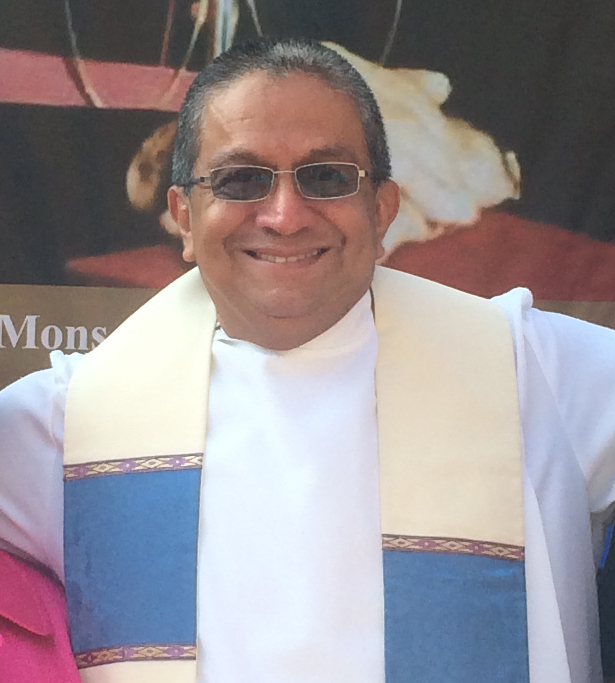 "I am a CISPES supporter because continuing to fight for social justice and a more people-centered country means continuing the dream and sacrifice of thousands of my fellow Salvadorans who died for that vision.” - Padre Carlos, New York City