Alliance Veterans Remain Imprisoned After Second Trial Suspension

For the second time in less than a month, the First Tribunal Against Organized Crime in San Salvador has suspended the trial of nine Salvadoran Civil War veterans and former combatants from the Alliance for a Peaceful El Salvador and communications volunteer Luis Menjivar, further prolonging more than two years of pretrial detention in a case already marked by serious due process violations. This time, however, no new date for the trial has been announced.
The trial had initially been scheduled for August 11–14, but the court suspended the hearing after claiming that technical problems prevented a virtual connection with La Occidental prison in Santa Ana, where the defendants are being held. It was rescheduled to begin on September 7 and continue throughout the week. Then, late on Friday, September 5, the court abruptly suspended the hearing again.
Once again, the tribunal cited problems establishing a virtual connection with the prison. It also reportedly pointed to medical appointments scheduled for some of the imprisoned defendants during the week.
Lourdes Palacios, spokesperson for the Committee of Families of Political Prisoners and Persecuted Persons of El Salvador (COFAPPES), questioned the repeated use of technical problems to justify delaying the proceedings. “It is striking that once again there is no virtual connection. That was the excuse in August, and now once again there is no virtual connection. In a country whose public institutions boast of having the most advanced technology available for other activities, in this case they have been unable to make a virtual hearing work,” she said.
Palacios also questioned why the court would suspend an entire trial because some defendants reportedly have medical appointments, rather than ensure their physical presence in court. “If that were the case, why not hold the hearing in person? What is most concerning is that the hearing has been delayed again and there is still no date. There is no date scheduled for the next hearing.”
The repeated suspensions have intensified concerns among family members and human rights organizations that the delays may be serving to prolong the defendants’ imprisonment in a case in which the prosecution has yet to present compelling evidence against them.
For the family of Atilio Montalvo, one of the veterans prosecuted in the case and a key negotiator of the 1992 Peace Accords, the repeated delays raise the possibility that authorities are using the judicial process itself to extend the punishment. Currently, Atilio Montalvo is the only defendant under house arrest due to health conditions; the other nine remain imprisoned.
They denounced what they described as possible delaying tactics by the judicial and prison systems, arguing that neither the inability to establish a virtual connection nor the scheduling of medical appointments justifies suspending the proceedings. If the prison system cannot guarantee a virtual connection, they argue, the defendants should simply be transported to court so that the hearing can take place in person.
The family warned that, in a case where the evidence is weak, continued postponements risk turning pretrial detention itself into punishment.
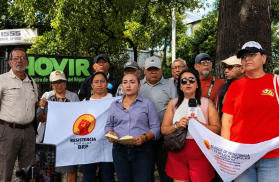
During a press conference alongside organizations demanding the defendants’ release, Atilio Montalvo’s daughter denounced that “media reports have revealed that the prosecution will not present the witness of dubious existence whose complaint formed the basis of the accusation.” Instead, she explained, the prosecution is expected to rely on police officers involved in the arrests and experts who extracted information from electronic devices and handled or destroyed alleged explosive materials. Family members and organizations supporting the defendants have raised serious questions about these procedures, including the reported absence of defense counsel during key stages of the handling of evidence.
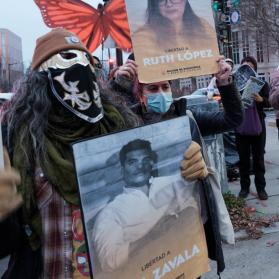
The defendants were arrested between May 30 and June 3, 2024, after being accused of allegedly planning acts of terrorism around President Nayib Bukele’s June 1 inauguration. Salvadoran and international human rights and solidarity organizations have denounced the allegations as fabricated and as an attempt to criminalize peaceful organizing and political dissent.
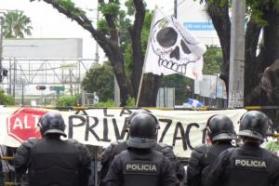
Their prosecution before a Tribunal Against Organized Crime and an anonymous, or “faceless,” judge has raised further concerns in the context of widespread political persecution and compromised judicial independence in El Salvador.
Human rights defender Celia Medrano argued that the judicial system is increasingly being used against people who challenge those in power. “There are political prisoners in El Salvador. Their families are demanding justice, but justice appears to be completely at the service of those who currently exercise and control power.”
Medrano denounced the failure to respect basic guarantees of due process and the use of criminal proceedings against government critics. “To be a political opponent, to criticize state structures, means becoming a victim of the instrumentalization of justice for political retaliation by those who control power.”
After more than two years behind bars, the defendants remain imprisoned without a trial, without compelling evidence presented against them, and now without even a date for when their case will be heard. Therefore, their families demand that the hearing take place without further delays, that the detained defendants be brought physically before the court if the State cannot guarantee a virtual connection, and that they be acquitted and released in the absence of evidence supporting the charges.
The families and organizations are also calling on embassies and the international community to closely monitor the case and the announcement of any new hearing date.
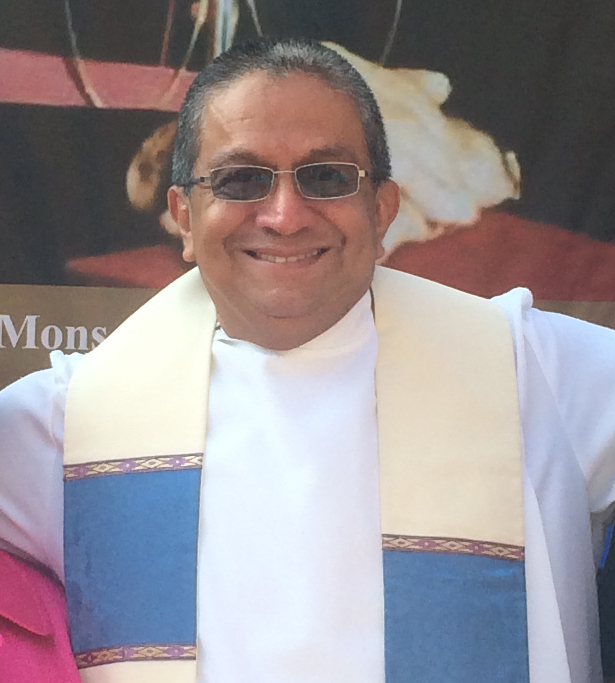 "I am a CISPES supporter because continuing to fight for social justice and a more people-centered country means continuing the dream and sacrifice of thousands of my fellow Salvadorans who died for that vision.” - Padre Carlos, New York City