International solidarity grows for the release of Ruth López

On July 16, after several weeks of an international visibility campaign for Ruth’s release, her sister, Claudia López, told the press that she had been granted a visitation with Ruth in mid-May, during which she stated that Ruth was experiencing life-threatening health complications and demanded answers regarding the results of a biopsy.
On May 18, 2026, renowned Salvadoran human rights defender and constitutional lawyer Ruth López marked one year in detention without access to a public trial, while remaining largely incommunicado. Throughout this period, civil society organizations, international human rights bodies, and U.S. lawmakers have called for her release and in the one-year mark carried out a series of actions calling for her immediate release and respect for her fundamental rights.
To mark the one-year since her arrest, more than 100 civil society organizations from the Americas and Europe issued a joint statement expressing deep concern over her arrest and called on the Salvadoran government to disclose her whereabouts, guarantee her access to legal representation, and ensure her physical and psychological well-being, while urging the international community to speak out in defense of López and the rule of law, as her incommunicado detention constitutes a serious violation of due process and at times has amounted to enforced disappearance.
At the same time, nine United Nations Special Rapporteurs and independent experts called on the Salvadoran government to immediately release López under alternatives to pretrial detention, arguing that her prolonged detention was unreasonable, disproportionate, and effectively amounted to punishment before trial.
The experts warned that the circumstances of her detention and procedural irregularities suggested she was being targeted for her legitimate anti-corruption and human rights work, and highlighted the case as part of a broader pattern of intimidation aimed at silencing women leaders in public life. Amnesty International likewise called for López's immediate release, a fair and public trial, and full respect for El Salvador's international human rights obligations.
In the United States Congress, Rep. Jim McGovern spoke on the House floor calling for her release. Speaking to his colleagues, Congressman McGovern described López's imprisonment as "arbitrary detention, a human rights violation" and said she is "being targeted for political reasons by an autocratic regime." He revealed that he had "asked the U.S. embassy to help Ruth. No response," and said he feared the U.S. government "is siding with the abusers rather than the defenders of human rights."
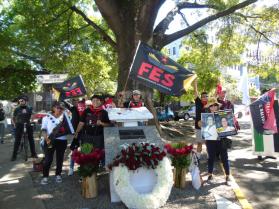
Rep. McGovern also joined a solidarity vigil outside the U.S. Capitol on June 3rd, where civil society organizations and human rights advocates gathered to demand Ruth's release. Opening the event alongside Kerry Kennedy, president of the Robert F. Kennedy Human Rights organization, McGovern reiterated his support for Ruth López and the need to defend human rights and the rule of law in El Salvador. McGovern said he was "sick and tired" of "this indifference to human rights" and of "getting on bended knee to praise tinpot dictators like Bukele."
During the vigil, Yesenia Portillo of the Committee in Solidarity with the People of El Salvador (CISPES) called attention to the causes Lopez championed, including her defense of those "unjustly arrested under the state of exception," as well uplifting the dozens of political prisoners, who like Ruth are "being politically persecuted" for denouncing "the crimes against humanity and the attacks on democracy that are happening right now in El Salvador." A former Cristosal board member present in the activity argued that López’s arbitrary detention "has become one of the clearest examples of the Bukele government's escalating repression against human rights defenders, journalists, and independent civil society."
Amanda Strayer, Senior Counsel for Accountability at Human Rights First, likewise argued that Ruth López's detention should concern the United States because it exposes "the abuse of corruption of an extremely abusive authoritarian government." She emphasized that, given the close relationship between Washington and San Salvador—including U.S. migrant transfers to Salvadoran prisons—"it's important that people in the United States call for Ruth Lopez's release in order to strengthen civil society in El Salvador, to fight back against these abusive practices."
Following the events at the U.S. Capitol, additional members of Congress publicly called for Ruth López's release. Delia Ramirez condemned efforts to silence dissent, stating, "They want to push dissent and they want to criminalize those who would be willing to speak truth to power." Ilhan Omar likewise declared that "The Bukele regime is trampling international law and basic human rights with impunity" and urged that "The United States must stop enabling Bukele's regime immediately," calling for the release of all political prisoners. During a Senate confirmation hearing, Chris Van Hollen also raised Ruth López's case directly with the nominee for Assistant Secretary of State for Western Hemisphere Affairs, describing her as "clearly a political prisoner" and asking whether the State Department would work to secure the release of political prisoners in El Salvador.
These Democratic members of Congress were joined by several colleagues in sending a formal letter to Secretary of State Marco Rubio calling on the U.S. government to take concrete action to secure Ruth López's release. The lawmakers urged the administration to "actively advocate for her release" and direct a U.S. embassy representative to visit her in prison. The letter argued the United States cannot defend human rights "based on its political views of the government detaining them."
In September 2025, the Inter-American Commission on Human Rights granted precautionary measures in favor of Ruth López, finding that her rights to life, personal integrity, and health were at serious and urgent risk. The Commission called on the Salvadoran State to protect those rights, immediately end her prolonged incommunicado detention, guarantee regular access to her family and legal counsel, and review the necessity of her pretrial detention in light of international standards. Despite these measures, it was not until more than nine months later—over 400 days after her detention—that Ruth's family was allowed to visit her for the first time.
Following the visit, her sister, Claudia López, reported "an evident deterioration in her health." "After a year of not being able to see my sister Ruth, I recently had the opportunity to hug her and let her know how much her family loves her, and how much solidarity and support she has nationally and internationally," she recalled, stressing that the detention remains unjust and that the right to family contact should be guaranteed for all detainees.

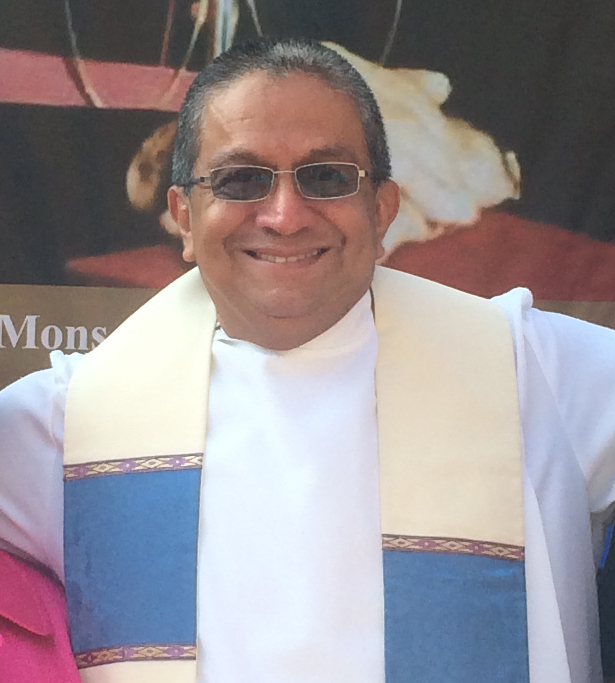 "I am a CISPES supporter because continuing to fight for social justice and a more people-centered country means continuing the dream and sacrifice of thousands of my fellow Salvadorans who died for that vision.” - Padre Carlos, New York City